Social Icons

Showing posts with label apple. Show all posts

Friday, May 22, 2015

Apple’s Small iOS 8.3 Updates Speak Volumes About Where It's Headed

What easier app downloads and Siri updates are really saying.


Apple siri iosApple may have finally succumbed to common sense: A reader at 9to5Mac
spotted some new settings in the upcoming iOS 8.3 software that suggest
iPhone users should get ready for easier app downloads and more
convenient voice features.

Judging by the iOS 8.3 beta, people
will be able to nix the password requirement for free downloads. The
update also points to a new Siri feature that can launch speakerphone
calls without touching the phone at all.

These feature updates
might seem incremental, but they hint at Apple’s larger play: They are
stepping stones to a future in which enjoying new Apple features and
talking to our Apple devices—on our wrists, at home and on the road—will
become second nature.

Password Play

Passwords weren’t always necessary for freebies,
but the iPhone maker inexplicably built in the requirement. Now it
appears users will be able to toggle it on or off in iOS 8.3. The beta
version, released last week, shows the setting under the new “Password
Settings” configuration page (in the iTunes & App Store settings).
Note that the change covers free apps, media or other iTunes offerings
only; there is no way to turn off passwords for paid downloads.

9to5Mac
notes that the setting hasn’t been activated in the beta software, but
it will likely be available in the final release.

See also: Apple's Emoji Characters Will Soon Look More Like The World
The new password option joins other changes spotted in iOS 8.3, including:

Advertisement — Continue reading below
  • Ethnically diverse emoji characters
  • Two-factor authentication for Google services
  • Apple Pay for China
  • Expanded Siri support for seven new languages
  • Improved keyboard
  • Wireless CarPlay features
The latter may offer a clue as to why Apple gave Siri control over the speaker.

What The Updates Are Saying

AAA Foundation For Traffic Safety took aim at voice features—Siri, in particular—last
fall, so Apple's efforts to appease critics with a simpler hands-free
calling for drivers makes sense, especially as part of Apple’s overall
push to make its technology vehicle-friendly.

Initially, users
could only trigger the Siri voice feature by holding down the home
button. Apple eventually gave users the ability to activate it by saying
“Hey Siri” (when the device is plugged into power). Users can now place
calls this way, but they’d still have to use headphones or hold the
phone up to their ear.

By allowing speech activation for the
speakerphone, there’s no need to physically handle the device at all,
just to place a call. Ideally, that should reduce driver distraction.

The company seems to be firing on all cylinders now. Its previous iOS 8.2 software, released a couple of weeks ago, brought Apple Watch support into the fold, as well as improvements to HealthKit and other bug fixes. Apple also filed a patent for an iPhone dock that could feasibly turn into a smart home hub for its latent HomeKit initiative, and is expected to release a brand-new Apple TV with the App Store and Siri, plus a new streaming live TV service.

The
common thread in most cases are apps and, increasingly, voice features.
Given that, Apple's focus on these areas should come as no shock. They
all play into the windfall of Apple technologies about to head our way.
That much seems to be loud and clear.

Lead image created by Adriana Lee for ReadWrite

 ReadWrite

Sunday, May 17, 2015

2015 Apple iPhone 6s and iPhone 6s Plus rumor round-up: specs, features, price and release date


2015 Apple iPhone 6s and iPhone 6s Plus rumor round-up: specs, features, price and release date
In
2014, Apple made the biggest upgrade to its iPhone lineup: it finally
introduced a larger iPhone, and not just one, but two models, the iPhone
6 and iPhone 6 Plus.


This year, in 2015, we don’t expect another
major redesign. Instead, rumors agree that Apple will stick to its
tradition of focusing on internal hardware and software updates in the
second year after it introduces a new design.


Now, the first
rumors have started coming in from reputable sources, and it’s time to
round up the picture around the 2015 Apple iPhones: the iPhone 6s and
iPhone 6s Plus, as most analyst expects them to be called.

More capable, 12-megapixel camera, and maybe, 4K video (finally?)

Apple
first featured an 8-megapixel camera on the iPhone 4s back in 2011, and
since then all iPhones have used 8-megapixel sensors with slight
variances in the size of the sensor itself. At the same time rivals like
Samsung, HTC and Sony have started using 16- and 20-megapixel main
cameras, which theoretically are capable of capturing more detail in
daylight but come with reduced pixels that make it harder to capture
great low-light images.


In 2015, it seems that it is time for
Apple to also make the jump to a higher-res camera, and rumors agree
that the iPhone 6s and iPhone 6s Plus will focus on the camera
experience with a brand new, 12-megapixel camera sensor.


A
12-megapixel sensor would also allow Apple to enable 4K video recording,
something that is not possible on an 8-megapixel camera.


We have
seen various rumors about this particular upgrade, including wild
theories about clip-on lenses introduced by Apple, and even a
mirror-like system that would allow using the rear camera also for
selfies, but so far, these seem like a far stretch. Having a
12-megapixel camera with some new shooting options and 4K video
recording, however, do seem possible and very likely.

Force Touch

Apple
first introduced Force Touch with the Apple Watch. A feature that
allows the device to know the difference between a slight tap and a
longer, more forceful touch on the display, this feat is already
available on the Apple wearable, and now rumors point out that it’s
coming to the new, 2015 edition of the iPhone.

We
find this rumor very credible for two reasons: it comes from various
sources, with reputable ones like KGI Securities’ Ming-Chi Kuo among
them, and it fits well in a tradition of synergies for Apple that we've
seen with the iPad mini design being adopted by others, as well as in
other occasions.


So far, though, it’s hard to say how will Force
Touch work on the iPhone. Also, having both a slight tap and ‘force
touch’ is not all that intuitive, and will take some getting used to.
Such a solution is also not a transparent one in many cases: what would
happen if you force touch in the Music app? what if you do the same in
the Photos application? and what about other places? We’re curious to
see how and if Apple implements Force Touch in the iPhone 6s.

Apple A9 expected to make the jump to 14nm, and - finally - an iPhone is coming with 2GB of RAM

Apple
has remained a leader in terms of benchmark performance (especially on
the CPU side) with the Apple A8 chip it introduced with the iPhone 6,
and the 2015 edition of the iPhone is practically certain to get the new
Apple A9.


Fine details about the Apple A9 chip are still under a
veil of secrecy, but there are some transitions that are very likely to
happen. First, we do expect the Apple A9 to be built by Samsung and not
TSMC due to the more advanced manufacturing that’s already available at
Samsung fabs. Apple chose TSMC as its supplier for the 20nm Apple A8,
and this year, Bloomberg has reported that it will make the jump to 14nm
with the Apple A9 with Samsung being the manufacturer.

Cross-section of Samsung's 14nm FinFETs in Exynos 7420, image courtesy of Chipworks
Most
importantly, this will also be a move from a planar design to FinFET
for the transistors in the chip. This is important as, at current
miniature nodes, planar architectures are affected by power leakage
issues due to the gate in planar architectures having a reduced control
over the source-drain channel, while FinFETs have their gate wrapping
around the channel (rather than just laying on top of the channel) and
are thus capable of keeping tighter electrostatic control over the
channel. And while Samsung is at its first generation of FinFETs, while
Intel is alread at the second one, it’s nonetheless remarkable how a
cheap mobile SoC will be edging closer to the expensive Intel chips,
using the same advanced technological process.

Speaking in
performance terms, we do expect this switch to a new node and
architecture to yield some substantial gains in performance. Last year,
Apple stated that the A8 brings 25% more CPU performance and 50% more
graphics performance while drawing only 50% of the power compared to the
Apple A7, and we’re curious to see what the numbers will be this year.

Improved design: sturdier, 7000 series aluminum, and a rose gold option

The
iPhone 6 Plus was widely accused of being prone to bending, even under
lighter pressure, and this bend-gate was quite the hot topic around the
launch of the phone late in 2014. Apple seems determined to put all
chances of such deformation occurring even under slight pressure to
rest, as rumors say that rather than using 6000 series aluminum, the
2015 generations of the iPhone might come with a sturdier 7000-series
aluminum alloy. If this change does indeed happen, it’s not certain
whether Apple will advertize the new material all that much - given all
the controversy around the issue - but this new alloy does seem like a
credible possibility.


Interestingly, rumors also speculate that
Apple is working on adding a fourth, ‘rose gold’ color option for
iPhones along with the current gold, space grey, and silver models.

A concept for a rose-gold iPhone

Apple iOS 9: the big launch for Beats

One thing that seems
practically certain is that the new iPhones will run on iOS 9. Apple
hasn’t skipped a year since the launch of the original iPhone in 2007,
introducing new versions of iOS every year. This year, we expect to see
iOS 9 at WWDC 2015 on June 8th, and while the feature list for the new
version of the platform is not official yet, the big highlight is
expected to be the re-introduction of the Beats music subscription
service.


Apple seems to have built a lot of momentum in the music
industry, and with names like Taylor Swift and others leading what
looks like an open war with Spotify, the new Beats Music subscription
service could snatch some high-profile exclusive artists. So far,
expectations are that all-you-can-eat music with Beats will cost $10 a
month, just like Spotify.

Apple iPhone 6s and iPhone 6s Plus price and release date

Finally,
the iPhone 6s and iPhone 6s Plus are not likely to surprise us when it
comes to their price and release date. Apple keeps a steady yearly
cadence with its iPhone announcement, and if this year is part of that
repetitive pattern, the iPhone 6s and 6s Plus announcement should happen
on Tuesday, September 8th with a release date on Friday, September
18th.


The prices will also likely be unchanged at $200 for the iPhone 6s and $300 for the iPhone 6s Plus on a two-year contract.

What do you want to see in the next iPhones and are you happy with the rumored changes? Let us know in the comments below.

Thursday, December 18, 2014

Apple reportedly opens first official retail store in the Philippines


Apple has reportedly opened its very first official retail store in the Philippines, six years after it launched an online store in the country.


But unlike Apple’s usual standalone retail outlet, the store is part of a multi-brand gadget and appliance center.


The store is located on the ground floor of the newly opened Abensons
building at the corner of 5th Avenue and 28th Street in Bonifacio
Global City, Taguig, Metro Manila.


The local tech blog YugaTech
has confirmed with a marketing manager that the store is indeed an
official Apple retail location, as opposed to being an authorized
reseller only.


According to the site, although it’s managed by Abensons, the store
was curated by representatives from Apple’s headquarters in Cupertino,
California, and its construction cost Apple an estimated P50 million
($1.1 million).


The store is set to feature a Genius Bar, which will be staffed by Geniuses upon completion of their training.


Perhaps because of its relatively small-scale operation, the store is not yet listed on Apple’s online list of official retail stores.


Last week, it was reported that Apple would be opening its first retail store in Brooklyn, New York, as early as April 2015.
 -- AppAdvice

Thursday, October 30, 2014

Retailers' alternative to Apple Pay just had a security breach


Apple_pay-3
The Merchant Customer Exchange (MCX), a consortium of more than 50 U.S. retailers working on an alternative to Apple Pay, announced Wednesday that its service, called CurrentC, has experienced a security breach.

"Within the last 36 hours, we learned that unauthorized third parties
obtained the e-mail addresses of some of our CurrentC pilot program
participants and individuals who had expressed interest in the app," a
representative for MCX said in a statement provided to Mashable. "The CurrentC app itself was not affected."

While payment details were apparently not impacted, the incident
nonetheless casts an unflattering light on CurrentC at a time when the
payment service is already receiving greater scrutiny.

CVS and Rite Aid backed away from Apple Pay in favor of CurrentC, which one report suggested may be the result of fines retailers could face for breaking their contracts with MCX. (MCX has since put out a blog post confirming the exclusivity aspect, but said "there are no fines.")

CurrentC was first announced in 2012, well before Apple unveiled its
payment option, but it won't hit the market until sometime next year. At
first blush, CurrentC is a clunkier alternative that requires customers
to scan QR codes in order to make in-store payments. The email breach
may also raise questions about whether it's as secure as Apple Pay.

Apple CEO Tim Cook said earlier this week that more than one million credit cards were activated in Apple Pay in the first 72 hours.

Tuesday, October 21, 2014

Apple iPhone 6 (Apple A8) performance review: CPU and GPU compared to the best Android phones out there

Apple iPhone 6 (Apple A8) performance review: CPU and GPU compared to the best Android phones out there
When
it comes to performance and power there is no device so widely
misunderstood as the iPhone. The new iPhone 6 (and iPhone 6 Plus) is no
exception - you’d find bashful comments about its comparatively low
clock speed, ‘only’ two CPU cores, low amount of RAM, lack of expandable
storage, and what not in practically every online forum.


Looking
at numbers without fully understanding them, though, is a dangerous
business. This iPhone 6 performance review aims to clear some of the
widespread misunderstandings and give a more detailed overview of the
state of mobile CPUs, and how Apple’s efforts compare to that of the
main rival: the mostly Qualcomm-powered Android fleet.

Apple A8 and ARM's architecture license

When
it comes to the CPU, it’s worth starting off with a quick refresh on
the facts. The overwhelming majority of mobile devices - be it Android,
Windows Phone, or iOS ones - are based on ARM-derived architectures. ARM
offers two types of licenses to its clients: a processor license and an
architecture license.


Most manufacturers use the processor
license that grants them the right to take an ARM-designed core and use
it in their SoC. An example for ARM-designed cores include the
battery-optimized Cortex A7 (and its newer, 64-bit Cortex A53 successor)
and the Cortex A15 (with its newer, Cortex A57 64-bit heir). Phone
makers like Samsung, for instance, take those two cores and combine them
in various big.LITTLE combinations to come with SoCs like the Exynos
5430 in the Galaxy Alpha where the company combines four power-efficient
A53s running at lower clock speeds and four performance-driven A57 that
can go up to higher clocks, but also draw more battery.


The
other type of licensees, those under ARM’s architecture license program,
take a totally different approach by just using the ARM instruction
set, while building their own CPU core. The most prominent companies
that do that are Qualcomm and… Apple. Apple used to operate under an ARM
processor license all the way until the iPhone 4s, but decided to
switch to an architecture license for the iPhone 5, and has building its
own CPU cores ever since then.

The state of 64-bit

Apple iPhone 6 (Apple A8) performance review: CPU and GPU compared to the best Android phones out there
Looking
at this timing, you see how this coincides with Apple’s industry-first
introduction of 64-bit chips - the first 64-bit phone, the iPhone 5s,
arrived two years after Apple introduced its first processor, and Apple
has clearly used this time slot to outpace the industry. To this day,
Apple remains uniquely positioned in the transition to 64-bit on mobile -
all first-party apps were 64-bit-ready on iOS 7 launch date, and the
company has given developers an ample timeline and great tools to
optimize their app quickly and effortlessly to 64-bit. With extremely
low levels of fragmentation in Apple’s ecosystem (where by fragmentation
we mean that iOS adoption rates are high and happen in days, while on
Android transitions span months, if not years), the company is one year
away from having a lineup consisting of 64-bit devices only. This will
happen next year when the Apple iPhone 5 is expected to go out of
production, and the 64-bit iPhone 5s with Apple A7 (or as speculated, a
plastic derivative of the 5s with similar hardware) takes the lowest
place in Apple’s ecosystem.


Looking over to the Android camp,
we’re seeing that the platform lags behind a full year and more. To this
date, in late 2014, the biggest Android vendors like Samsung, HTC, LG,
and others, are all releasing their flagships with 32-bit chips like the
Snapdragon 805 and Snapdragon 801. Both those chips are based on the
now 3-year old Krait core (with some tweaks, of course), and later on in
this article you’d be able to spot the difference in compute power.
Naturally, using the 32-bit 805 translates into those flagships not
being able to benefit from ART optimizations in Android L.


The
earliest this could (and likely would) change is in spring of 2015 when
the first wave of Android flagships for next year is expected to arrive.
Some (and hopefully most) of those devices are said to feature the
Snapdragon 810, Qualcomm’s first top-level 64-bit SoC. In just over a
year time, Qualcomm has overhauled its portfolio to consist of 64-bit
chips on practically all levels, from the low to the high-end. However,
the Snapdragon 810 does not ship with a custom Qualcomm core (such a
core would likely take more time for development) - instead, the company
goes back to using an ARM processor license and equips the 810 with a
big.LITTLE setup with four low-power Cortex A53 and four
performance-driven Cortex A57 cores.


Given the long period of
time it takes for the Android install base to switch to an ART-enabled
version of the platform in meaningful numbers (let’s keep in mind that
we don’t have a minimum target for ART, and chances are that it won’t be
KitKat, but Android L), it is clear that Android is in a much less
favorable position in terms of 64-bit-readiness.

Apple A8 die break-down

Both TSMC and Samsung are said to be making the A8 in a 40-60 ratio
Being
as secretive as Apple is (the company does not disclose processor
details in the way Intel does) hides a little joy for us, tech
reviewers, to try and reverse-engineer its efforts.


We’re not
completely in the dark, though: in the past two release cycles, Apple
has been disclosing the number of transistors in the Apple A8: there’s
now a whopping 2 billion of them, double the number from the A7. As far
as we can tell, this is the most ever in a smartphone chip - in
comparison, some estimates claim that the Snapdragon 805 chip features
700 million transistors.


From here on, the journey towards a
better understanding of the Apple A8 starts with a teardown of the
iPhone 6 and images of the A8 die from Chipworks. Those images give us a
detailed breakdown of the Apple A8 die and the location of its various
components.


Despite (or rather because of) the doubling of
transistor count, the die size has grown smaller and comes in at 89mm in
the A8, down from 102mm in the A7. Apple has switched the places of
components on the die, and the CPU is now on the bottom left (it was on
the bottom right), with a large block of L3 cache above it. Despite a
20% decrease in the size of the SRAM block (cells have shrunk in third
from 0.12µm to 0.08µm), it’s likely that more advanced circuitry makes
up for the difference and we’re still dealing with 4MB of L3 cache
memory. At the time of this writing, we have seen the first benchmarks
showing that memory latency has indeed improved by a hefty 20ns when we
go out to L2 $ and further.


The most drastic change in size,
however, seems to be in the CPU die size: the new CPU measures 12.2mm,
nearly 30% smaller than the 17.1mm CPU die in the Apple A7. By all
visible clues, the rest of the architecture remains the same: we have
64KB/64KB of L1 instruction/data $ (L1 is the fastest cache, located on
the CPU die), and a 1MB block of L2 cache shared between the cores.


Apple
has provided a few important details about the CPU performance of its
new A8: first, the company says the new CPU comes a 25% performance
improvement, and illustrates this with a chart showing generational
improvement all the way since the 2G iPhone (the 25% number is derived
by comparing the iPhone 5s’s 40x CPU overhead over the 2G iPhone and the
50x peek in the iPhone 6).


On clock speeds and deceptive marketing

With a modest
boost in CPU clock speeds from 1.3GHz to 1.4GHz (an 8% speed-up), the
25% improvement obviously comes from various other tweaks and tricks.
Before diving deeper in benchmarks, though, here is the place for a
quick insert about clock speeds and the state of the industry.
Commentators in forums are quick to point out the apparent inferiority
of Apple clock speeds in comparison to the much faster speeds declared
in rival Snapdragon and Exynos chips, for instance. The most up-to-date
example is the Snapdragon 805 with a declared clock speed of ‘up to
2.7GHz’. At first sight, Apple’s Cyclone core looks like a sore loser
with its declaration for just half that at 1.4GHz.


Most people
would call it a day at this point - the Snapdragon outperforms the A8
hugely, case closed. This, however, would be naïve: running real-world
applications and games shows instantly that the 2.7GHz speeds can only
be achieved for a very short periods of time, but after those short
outbursts, the chip quickly throttles back to the much more sane
~1.3GHz. Put simply, the 2.7GHz number that you read about is not the
nominal frequency, but maxed out turbo speeds that are not sustainable
for the long term. In fact, Apple is being much more truthful as it
declares actual nominal (and not turbo) speeds for its chip, plus, the
company goes on to disclose a second big thing about its chip: sustained
performance times. Apple actually claims its A8 is capable of running
flat at its nominal speeds for (at least) 20 minutes.


This is the
right place to note that ARM, the licensee company for both the
Snapdragon and the Apple A8 CPU cores, has actually claimed that the
current generation of its processors works best in terms of thermal
output/performance at around 1.2GHz. Going up above that ensues big
consequences - AnandTech has earlier shared estimates that going above
the 1.5GHz threshold by just 100MHz brings up a shocking, quadratic
increase in voltage and power consumed by the chip.

Apple iPhone 6


Monday, October 20, 2014

The 5 lessons both IT and business should learn from Apple


Apple background image


Tired of being ineffective and unloved? It's time to act different

InfoWorld

Sep 16, 201

When Apple Pay was announced
last week, I very quickly saw IT folks at retailers and elsewhere
saying it was old technology. Platform partisans were quick to point out
that Android phones have had the required NFC chips for several years,
and Google has its own wallet technology. I also heard CIOs quickly
declare that because Apple was a technology company, Apple Pay would not
be secure.

Those reactions were, to be blunt, stupid. And they're emblematic of the
dilemma that IT finds itself in: unloved by users, distrusted by
managers, considered an incompetent, expensive, yet necessary evil to
keep thing running. InfoWorld's editor in chef, Eric Knorr, was asked at
a recent VC conference about IT's role in this era
of cloud computing and technology-savvy users, and the question brought
him short, as it did his fellow panelists. Houston, we have a problem.

Although the "think different" theme is now cliché, it does speak to a
core reason why Apple is Apple and no one else comes close. If IT
organizations and their management partners understood the Apple way,
perhaps they could become Apples in their spheres: groups that make real
money even without majority market share, loved by their customers, and
able to drag much of the industry along. I've followed Apple as a user,
reporter, and editor for 23 years, and what makes Apple Apple is quite
clear

Lesson 1: Work through the whole problem

There are no silver bullets. Yet so many people think adding this
technology or that business relationship will magically make them
succeed. When Google convinced its Android makers to add NFC to phones,
the banking industry and retail industry ignored it. An NFC chip may be
useful as the communications mechanism, but the issue is deeper.

The payments issue is complex, but a key challenge was that the customer
credit card data was being stolen both at the point of sale through
magnetic skimmers and shifty employees, as well as from the data centers
by insiders working with cyber criminals. Moving the credit card data
from a magnetic strip to a chip-and-PIN to NFC does you no good if the
sales terminal is compromised, as we saw with Target last year and with Neiman Marcus and Home Depot this year.

If you move valuable information through lots of networks and accessible
devices, you have an indefensible perimeter. Apple Pay does away with
that issue by sending one-time codes from the iPhone to the sales
terminal, matched to a unique user ID. The reconciliation happens on the
back end through presumably highly secured, low-footprint connection

On the phone, the unique ID is stored on the Secure Elements chip,
inaccessible from apps. The fingerprint in the Touch ID is likewise
stored in that chip. Thus, the attack surface is smaller and hardened,
and the data is abstracted from the credit card itself. (John Beatty has
written a great technical description of what Apple is doing on the security front for Apple Pay.)

To develop Apple Pay, Apple had to work through several issues: the
communications technology, the security issues (on the device, at the
sales terminal, and at the data centers), the user experience, and the
card collection method (through the Passbook app, in this case).

Note "user experience" -- this is an area where IT usually fails.
Technical persona are different than business persona, but that's become
a convenient "why we can't" explanation to keep IT down. People use
technology, and it needs to feel and work "right." As long as IT ignores
this or pays lip service to it, it won't be working through the whole
problem it needs to.

 | InfoWorld

Wednesday, October 01, 2014

Apple's Shellshock patch for Macintosh computers may be incomplete, say experts

Apple just released a patch for the Shellshock bug that could give hackers access to Macintosh computers, but a security expert believes Apple fixed only two out of three security holes.


appcybersecurity300x225.jpg
Apple issued a fix for the Shellshock bug, also known as Bash, that could allow hackers to gain access to Macintosh computers. But security experts said on Tuesday that Apple's patch is incomplete, and leaves one vulnerability wide open.
Shellshock affects most computers around the world running Unix and Linux, including Apple's OS X operating system software for the Mac. A quarter-century old, the Shellshock flaw allows potentially harmful code to run inside a bash shell, which is a common, simple interface for issuing commands to the computer. Potentially, the Shellshock bug could be used to access sensitive information or gain control of the computer.

Tod Beardsley, an engineering manager for security firm Rapid7, told CNET last week
that Shellshock is extremely dangerous because it's easy to exploit, and can gives hackers the ability to take over your Mac. Some researchers have said it's at least as dangerous as Heartbleed, a
similar widespread vulnerability discovered earlier this year.

If you have a Macintosh, you want to be sure to install these security updates to ensure the safety of your Mac.


osx-shellshock-bashcheck.png
Rapid7 security researcher Greg Wiseman's work showing that OS X Mountain Lion is open to a third Shellshock vulnerability.
Screenshot by Seth Rosenblatt/CNET
Apple fixed two vulnerabilities yesterday, but a third Shellshock vulnerability in OS X was discovered by another Rapid7 security researcher, Greg Wiseman. He says he ran a script
to test for Bash/Shellshock vulnerabilities and found that even after installing Apple's patch on OS X Mountain Lion (released in 2012) the operating system was still susceptible to another vulnerability. That vulnerability, CVE-2014-7186, is a bug that could allow for Denial of Service attacks, which would prevent a Mac from connecting to local networks or the Internet.

Apple didn't respond to a request for comment.

Apple issued its patch on Monday afternoon, five days after first word of the
bug began to spread on September 24. Apple's patch addressed two Shellshock vulnerabilities, known as CVE-2014-7169 and CVE-2014-6271.

Apple's fix has yet to be added to its Software Update service for Macs, which pushes updates to the computers automatically. For now, Mac users need go to Apple's site and download the patches for OS X Lion (10.7), OS X Mountain Lion (10.8) and OS X Mavericks (10.9). If you want to know which version of OS X your Mac is running, go to the Apple Menu in the upper left corner and click "About this Mac."

Apple said last week that only Mac owners who use advanced Unix settings are
affected. "Bash, a UNIX command shell and language included in OS X, has a weakness that could allow unauthorized users to remotely gain control of vulnerable systems," said Apple. "With OS X, systems are safe by default and not exposed to remote exploits of bash unless users configure advanced UNIX services."

 - CNET

Sunday, September 28, 2014

Can't Go Back Now: Apple Stops Supporting iOS 7

Can't Go Back Now: Apple Stops Supporting iOS 7
With every new iOS update, there are bugs and glitches. Oh man, were there ever glitches with iOS 8. For a brief time, if you knew how, you could go back to the sane stability of iOS 7. Not anymore—Apple stopped signing iOS 7.1.2 on Friday afternoon.

This, of course, was bound to happen. Apple likes to nudge its users along to the latest OS as quickly as possible, and for the most part that's a good idea: The newest software has the newest security patches, even if you're running an older device that can't take advantage of all the new
software's bells and whistles.

But with iOS 8.0.1 breaking users' phones to the point where they couldn't make calls, and iOS 8.0 seriously bogging down some older hardware, it was nice to have an escape route back to iOS 7, even if it was a convoluted one.

No such luck any more. If you've got iOS 8, you're there for life—or at least until the next update rolls out. [AppleInsider via CultOfMac]

Friday, September 05, 2014

Apple's New Lightning Cables Could Be Reversible on Both Ends

Apple's New Lightning Cables Could Be Reversible on Both Ends


Apple's reversible Lightning connectors are a great little convenience,
but you've still got to plug them into your wall wart or computer the
right way, because USB connectors are horrible and out to get you. But according to accomplished Apple leaker Sonny Dickson, Apple's new Lightning cables could get reversible superpowers on both ends.

Yes, the next standard for USB has reversible cables in mind,
but Apple's new cables could bring that wonderful future to us in just a
month or two with a simple and clever modification. Instead of having
pins that take up roughly half of the connector's mouth, these new
cables appear to have a thinner layer of pins that floats in the center
of the connector, with room on both sides for the complimentary protrusion that sticks out of your wall wart or computer.

Rumors of this reversibility trick have been floating around elsewhere, but this beautiful future seems more likely than ever considering that Sonny Dickson—the dude who leaked the iPhone 5C in great detail
and has a near perfect track record—has apparently gotten his hands on
some of these puppies. These could be being manufactured for some third
party Lightning cables, or a fabrication entirely, but let's hope for
the sanity of everyone everywhere that these are real and impending.

With
iPhone day around the corner, we should find out for sure pretty soon.
And maybe, just maybe, we can see this heroic tech come to the USB side
of some non-Lightning cables before that next version of USB rolls
around. God knows we could all use it. [Sonny Dickson]

Wednesday, August 27, 2014

Apple patents flexible display with buttons hidden underneath

In two weeks, Apple is set to show off the features of its eagerly anticipated iPhone 6 handset.

But while the world waits for the new smartphone, engineers at the firm's headquarters in Cupertino, California, are busy patenting futuristic features that could one day appear in iPads and iPhones.

In a patent granted today, plans are revealed for a mobile device with a
flexible screen with hidden buttons beneath its surface.

In a patent granted today, plans are revealed for a mobile device with a flexible screen. This image shows how temporary  raised buttons (22) could push upwards under a screen (102) on demand, giving users the feeling of pushing a physical button, like the home button on an iPhone
In a patent granted today, plans are revealed for a mobile device
with a flexible screen. This image shows how temporary  raised buttons
(22) could push upwards under a screen (102) on demand, giving users the
feeling of pushing a physical button, like the home button on an iPhone

The patent granted by the US Patent and Trademark Office suggests that buttons and
microphones could be hidden by the screen in a number of ways.

In one scenario, future mobile devices would feature physical buttons - such as the Home button - embedded under their displays, which would
flex or 'deform' to enable users to push them down, Apple Insider reported.

In another scenario, the screen could be placed over actuators - tiny
motors. They would press upwards to generate temporary buttons on-demand
anywhere on the screen and provide haptic feedback.

By hiding 'buttons' under a screen using either method, Apple could expand the
size of an iPhone or iPad screen, without making the devices themselves
bigger and bulkier.

While these functions appear to be predominantly intended for the iPhone and iPad, the patent also shows how the technology could be incorporated into a MacBook¿s trackpad, to create ridges (102) and make a future laptop (without a groove on its side) easier to open (pictured)
While these functions appear to be predominantly intended for the
iPhone and iPad, the patent also shows how the technology could be
incorporated into a MacBook’s trackpad, to create ridges (102) and make a
future laptop (without a groove on its side) easier to open (pictured)

WHAT TO EXPECT IN THE IPHONE 6 

The handset is expected to be unveiled on Tuesday 9 September and will come in 4.7-inch and 5.5-inch sizes.

It is thought the phone could boast a flexible and scratch-proof sapphire
screen, which is about to go into large-scale production in the US.

The screen is tipped to be ‘Retina display+’ with a 1,704x904 resolution.

Experts also predict a faster A8 processor, better rear-facing camera -
possibly with changeable lenses -and wireless charging support.

It may also include a heart rate sensor like the Samsung Galaxy S5.
There is increasing demand for phones with larger screens, with Samsung among
the manufacturers offering multimedia-friendly Phablets – a cross
between a phone and a tablet.

Apple is rumoured to be launching its iPhone 6 in two sizes - 4.7-inch and 5.5-inch – to cater to
consumers who want a larger screen on their phone.

The technology described in the patent could mean that Apple mobile devices of the
future are ‘all screen’ and that they could grow or reveal buttons when a
user needs them.

The patent reads: 'The ability of a user to compress a component such as a button switch by deforming the flexible display may allow the area of a device available for visual display to
be enlarged.

'For example, the active area of a flexible display may overlap a component such as a button or speaker.'

'Diaphragms' capable of being used as a speaker or microphone could also be hidden under the screen, according to the patent.

While these functions appear to be predominantly intended for the iPhone and
iPad, the patent also shows how the technology could be incorporated
into a MacBook’s trackpad, to create a large ridge that would push up
the laptop's lid.

This could mean that future MacBook designs will be more streamlined and that there will no longer be a ridge to open them.

As with any patent, there is no indication about whether the technology described really will feature in a future product.

By hiding buttons under a screen, Apple could expand the size of an iPhone or iPad screen, without making the devices bigger. Consumers are increasingly demanding larger handsets and the iPhone 6 is rumoured to come in two sizes - 4.7 inches and 5.5 inches. Leaked images of the rumoured handsets are shown
By hiding buttons under a screen, Apple could expand the size of an iPhone or iPad screen, without making the devices bigger. Consumers are increasingly demanding larger handsets and the iPhone 6 is rumoured to come in two sizes - 4.7 inches and 5.5 inches. Leaked images of the
rumoured handsets are shown

 | Mail Online

Leaked iPhone 6 Guide Appears to Confirm Launch Date, Other Details

Leaked iPhone 6 Guide Appears to Confirm Launch Date, Other Details
Expand
iPhone rumor season is just days away from becoming iPhone reality season, and a new leak from a usually reliable source appears to confirm some basic details.

The French tech blog Nowhere Else just published images of an iPhone 6 Quick Start guide.
The document includes the rumored iPhone 6 name as well as the location
of the sleep/wake button on the righthand side of the device, instead
of the top where it's historically been on the iPhone. The rumored
announcement date of September 9 is also displayed on the screen, which
is consistent with guides from past releases. Aside from the apparently
larger screen, everything else pretty much matches the existing iPhone
design.

It would be easy to write this off as a quick and dirty Photoshop job,
but Nowhere Else has a decent track record. Last year, the blog
published a similar Quick Start guide for the iPhone 5S
just hours before the official announcement. That guide, which
apparently came from the same source as the iPhone 6 guide, correctly
identified the existence and name of the Touch ID home button. It's also
worth noting that that guide looked more complete, whereas this one
appears to be some sort of draft.

So, either way, there's reason to believe that this leak is legit.
We'll have to wait another 15 days (or so) to know for sure. But in the
meantime, you can check out our rumor round up and take a full look at what we're expecting. [nowhereelse.fr]

Leaked iPhone 6 Guide Appears to Confirm Launch Date, Other Details

Report: Apple set to announce its next-generation coprocessor, the 'M8'


In 2013, Apple introduced the M7 coprocessor alongside the A7 chip. It
shouldn’t come as much of a surprise then to know that Cupertino is
working on an updated coprocessor codenamed “Phosphorus,” according to Chinese media (via G for Games).


Little is known about the “M8,” though many speculate that it will
help collect and interpret health-related data for the “iPhone 6” and
the company’s new Health app. The M8 is likely to launch with the
long-rumored “A8” processor. The M7 coprocessor was designed to measure
motion data from an iOS device’s accelerometer, gyroscope, and compass.
It’s primarily used for fitness apps that track user activity.


10253-2409-005vDhTugw1ejgzchscgej30ip09w0u0-l
In July, it was reported that Apple’s next chip could push speeds to heights
never before seen on iOS devices. In fact, the chip likely to be found
on the iPhone 6 and “iPad Air 2” could boast frequencies of 2.0 GHz or
more per core. The iPhone 5s features a 1.3Ghz A7 SoC processor.


The A8 is expected to continue to adopt a 64-bit dual-ore
architecture found on the A7 processor and continue to be built using
the 20-nanometer process.


The iPhone 6 is expected to make its debut on Tuesday, Sept. 9.
 -- AppAdvice

Sunday, August 24, 2014

The Long Anticipated Apple iPhone 6 leaked by China Telecom

The Apple iPhone 6 is hardly the best kept secret in the world with rumors about the
upcoming flooding the internet lately. And while we have already accepted the fact that the Cupertino giant’s security measures aren’t what they once were, it’s still interesting to see a high-profile leak
such as this one.

China Telecom, one of the Apple’s largest partners, jumped the gun and announced the iPhone 6 through its official Weibo account. The posthas since been deleted, but the delay was still enough for it to be copied and shared all over the web.

The post gave us a photo of the Apple iPhone 6 in its three color versions, along with a few bits about its cellular specifications. The smartphone will be available unlocked and will support LTE, 3G, CDMA and GSM networks. China Telecom didn’t sell unlocked iPhones until now, so that’s going to be a first for the carrier.

The Apple event that should see the iPhone 6 make its debut is scheduled for September 9 so there’s not long left until we find out all about the upcoming smartphone.

Source | Via - GSMArena.com news


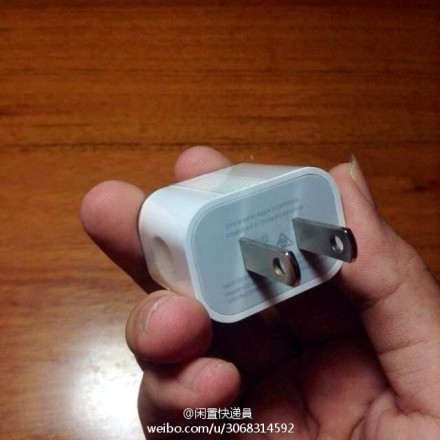
Could Apple introduce a new USB power adapter with its bigger 'iPhone 6' handset?


Apple could introduce a brand new USB power adapter alongside its bigger, 4.7-inch “iPhone 6” handset, according to a recently leaked image.

Cupertino is indeed reportedly planning on introducing a reversible USB-Lightning cable this fall, when its next-generation iPhone handset hits the market.

Much like its Lightning connector, this anticipated USB cable should
allow users to plug their iOS charging cable into an accompanying power
adapter without having to first align the USB connector.

However, accompanying this new Lightning-USB cable will be a new power adapter, according to one Weibo user. In a post uploaded to the social network (via MacRumors), the updated power adapter is shown off in a close-up image (pictured above).


As you can see, the new power adapter is smaller and more streamlined
than the current model used in the United States; it also features
indentations at both sides and is much like the 5W USB Power Adapter currently sold by Apple in Australia.


Recently, we’ve heard that Apple’s anticipated “iPhone 6” will indeed retail in a 128 GB version, and that a record number of “iPhone 6” units are expected to be sold by Cupertino during the handset’s launch weekend. As usual, we’ll keep you updated with further information as we receive it.


-- AppAdvice


Thursday, August 21, 2014

How Apple took over the only segment of the PC market that still matters | ZDNet

Apple, unlike most of its competitors, is remarkably
transparent about its sales. In its quarterly and annual earnings
reports, it routinely discloses both unit sales and revenue for each of
its operating segments.

In recent years, most attention has been focused on the eye-popping
numbers associated with the iPhone and iPad lines, which sold 150
million and 71 million units, respectively, in Apple’s 2013 fiscal year.

Compared to those stratospheric sales volumes, the Mac division
appears downright anemic, selling a total of only 16.3 million units in
the company’s 2013 fiscal year, the last full year to be reported. Macs
similarly represent only a tiny percentage of the global PC market, with
less than 6 percent of the 300 million PCs sold last year having an
Apple logo on them.

But those numbers are deceiving. Macs are still enormously
profitable, and their high average selling price makes this division a
formidable cash cow. In addition, Apple’s product planners have shrewdly
targeted the most important segment of the market, the only segment
that’s growing and the one that is by far the most profitable.

Thanks to that focus, Apple’s influence is much greater than those
seemingly puny market share figures would suggest. A closer look at the
numbers explains why.

Let’s start with a truism: Macs are PCs. They compete with high-end
Windows PCs in both business and consumer segments of the market.

Over the past decade, Mac unit sales have followed the same basic track as the rest of the PC market. After rapid growth in the
first decade of the new century (more than doubling between 2006 and
2010), sales appear to have stalled somewhat in recent years.


mac-unit-sales-2004-2013
Overall Mac unit sales, 2004-2013. Data from Apple SEC filings.

That chart only tells half the story, however. During the past
decade, the mix of Macs sold has shifted. In 2005, Mac desktops
(primarily the iMac) outsold all Mac portables combined. But that year
marked the beginning of a long, steady decline for Apple-branded
desktops, as the following chart makes clear.


mac-portables-increase-share
Mac portables (blue) versus desktops (gray) as a percentage of all Mac sales. Data from Apple SEC filings.

In 2012, the MacBook Air and MacBook Pro combined outsold all desktop
Macs by a three-to-one ratio. That trend has no doubt continued, but
you can’t tell from Apple’s SEC filings anymore: the company stopped
reporting the desktop/portable breakout beginning in the first quarter
of its 2013 fiscal year.

It’s a good bet that MacBooks now represent nearly 80 percent of all
Mac sales, with desktop models (iMac, Mac Pro, and Mac Mini) shrinking
quickly. By contrast, Gartner says 57 percent of all Windows PCs shipped
in 2013 were portables, including traditional notebooks and
ultra-lightweight MacBook Air competitors.

Apple is aiming quite deliberately at the one segment of the PC
market that matters, what Gartner calls “premium ultramobiles.”  (For
more details, see "High-end ultramobile devices carve a bigger share of the PC market as Chromebooks struggle.")

The MacBook Air is the quintessential example of this product
category, weighing under 1.6 kg in each of its two configurations but
with a display that’s large enough (at 11 or 13 inches) to be a credible
alternative to a more traditional notebook PC.

I estimate that Apple sold roughly 6.4 million MacBook Airs in its
2013 fiscal year, compared to about 6 million MacBook Pros. (I based
that calculation on two variables: First, I estimated that portables
made up 76 percent of all Mac sales in 2013. Second, I estimated an
average selling price of $1,050 for MacBook Airs and $1,500 for MacBook
Pros.)

If 6.4 million MacBook Airs sounds unimpressive for a full year’s
sales, put it in perspective: Gartner estimates that only 22 million
premium ultramobiles were sold in all of 2013. That gives Apple nearly
30 percent of this fast-growing market, which Gartner forecasts to grow
by roughly 50 percent this year and more than 70 percent in 2015.

It’s also a profitable segment, with average selling prices of $1000 or more.

That growth is why you see Windows PC makers falling over themselves
to deliver products in this category, with Microsoft’s Surface Pro line
and Lenovo’s Yoga series the best examples. All of the Windows-based
products include touchscreens, and most can be converted to a tablet by
either detaching and stowing the keyboard or flipping the screen over.

The MacBook Air is desperately overdue for a major makeover. Its
biggest competitive weakness is its non-Retina display, which offers
resolutions that can’t measure up to its Pro siblings or its Windows
rivals. I would not be at all surprised to see new MacBook Airs with
Retina displays this fall. I would expect those models to sell
spectacularly well in the holiday season.

Meanwhile, it’s impossible to compare Apple’s sales with those of its
rivals in this category, because none of them break out their results
with the same level of detail as Apple.

The detailed sales comparison every PC market watcher would love to see—Microsoft’s Surface Pro 3 versus the MacBook Air—isn’t
likely to happen unless Microsoft changes its longstanding policy and
begins disclosing actual sales figures for the Surface line.

| ZDNet

Monday, August 18, 2014

Report: Apple’s ‘iPhone 6’ heads to mass production

Mass production on Apple’s next iPhone is likely to begin very soon. This comes as the “iPhone 6” exits the product validation test (PVT) stage, according toChinese media (via G for Games).
According to the Wednesday report, Foxconn sources have confirmed that the testing phase on the iPhone 6 is almost complete. This is the process when “the assembly line is ran at full speed in order to detect any potential issues that may hinder the assembly process.” Hereafter, “the iPhone 6 will then enter mass production, just in time for its official unveiling.”
In recent days, new images have leaked purportedly showing parts for the next iPhone. They suggest the new device could have a protruding camera, embedded logo, and more.
This news comes a day after Bloomberg said that production has begun on the “iPad Air 2″ and “Retina iPad mini 2.”
Apple is likely to announce its next handset on Tuesday, Sept. 9. New iPads probably won’t be unveiled until later in the year. -- AppAdvice

Thursday, July 24, 2014

Could Apple finally be ready to unveil its mobile payment service?


A report from The Information is shedding new light on Apple’s plans for a mobile payment solution.


Even though there has been no news about the issue recently, the site
says Apple’s talks with payment industry executives have increased in
the past few months.


The big part of Apple’s system would apparently be the secure enclave found in the A7 chip of the iPhone 5s.
Currently, the enclave is designed to store scans from the pictured
Touch ID sensor. But that might change, according to the report:


Apple has told some partners its system would involve
a so-called secured element in the phones—a piece of hardware where
sensitive information such as a phone owner’s financial credentials can
be stored. The company also aims to run the system without giving up any
control to wireless carriers.
As of earlier this year,
Apple has more than 800 million credit cards on file, which is four
times more than e-commerce giant Amazon. That huge number gives Apple a
large amount of leverage to work with the payment processors.


In April, another report said that Apple was hiring senior executives for two new positions that deal with mobile payment issues.

Wednesday, July 23, 2014

Apple denies including privacy backdoors in iOS


In a recent research paper which highlights back doors and surveillance mechanisms in iOS devices, security researcher Jonathan Zdziarski brought to light some potential issues with the mobile OS that could potentially be used to compromise user privacy.

The paper argues that people with inside information of how iOS 7 operates could use vulnerabilities which are coded into the source code to install applications or extract data from devices, even without assistance from Apple.

Apple does have the ability to provide law enforcement with SMS messages, call history, contacts, videos and other media to law enforcement with a valid search warrant, but Zdziarski argues that advanced techniques exist to provide third parties with that information through ulterior methods. This allegedly includes more data than Apple can provide even as required by law enforcement, including deleted items.

iOS has since issued a statement to Financial Times journalist Tim Bradshaw, which was published on Twitter:

"We have designed iOS so that its diagnostic functions do not compromise user privacy and security, but still provides needed information to enterprise IT departments, developers and Apple for troubleshooting technical issues. A user must have unlocked their device and agreed to trust another computer before that computer is able to access this limited diagnostic data. The user must agree to share this information, and data is never transferred without their consent.

As we have said before, Apple has never worked with any government agency from any country to create a backdoor in any of our products of services."

It's worth noting that Zdziarski has stated that he's not looking to create a Snowden-esque security emergency with his paper. Instead he wants Apple to remove the questionable services from iOS devices, or at the very least to provide some level of disclosure as to why they're there.

Apple's 'iTime' Patent Hints at Possible iWatch Features


Appleiwatchpatent


A new patent granted to Apple
by the U.S. Patent and Trademark Office for a device called "iTime"
reveals what we might see in the company's much-anticipated smartwatch
device.


Believed to be called the iWatch (but referred to in a picture as
"iTime"), Apple has patented a wristband wearable device that supports
both arm and wrist gestures and features sensor-filled straps. In
theory, this could allow users to answer an incoming call by flicking or
shaking their wrist.


In one diagram, the device shows it can be removed entirely from the straps and can also serve as a portable media player.


iTime
The display is square-shaped (unlike the Moto 360
smartwatch) and alludes to the concept of having an iPod nano serve as
the centerpiece. The patent mentioned accelerometers, GPS modules, Wi-Fi
radios and haptic feedback, which applies vibrations and recreates the
sense of touch and motion to the user.


The patent, first spotted by Apple Insider,
highlights that the connected wearable syncs with iPhones, iPads and
other computers in what it calls a "personal wireless environment".


While it was first believed the iWatch may get an early fall launch date, production and distribution challenges may push back its debut to late fall.


The device is expected to come with a flexible AMOLED display with
sapphire cover glass, marking the first time the company has integrated
that type of display into a consumer product. Complications related to
"operation circuitry" (and shrinking it down to smartwatch size), as
well as making it a fully waterproof device and redesigning iOS to fit
on a smaller screen, are big indicators that we might not see the iWatch
for another few months.


Monday, July 21, 2014

Alleged iPhone 6 flyer leaks in China, hints September launch date with pricing


Alleged iPhone 6 flyer leaks in China, hints September launch date with pricing
There has been a steady stream of apparent leaks
and innuendo about the next generation of iPhone, expected to be
announced in the coming weeks.

If this image of a flyer out of
China is legit, then we can expect to see the new Apple make its way
into the eager faithful’s hands in mid-September, the 19th to be exact.

Pricing for mobile devices is different in all corners of the globe for a variety of reasons, and the iPhone is no different.
Outside the United States, items like smartphones tend to cost more
due to market scale, but mostly because of purchasing power and taxes. 
Pretty much by every measure, that means the iPhone (and other devices)
costs more everywhere outside the US. If this flyer is accurate, that
will be the case in China too. The 4.7-inch iPhone will cost 5,288 yuan
(approx. $850), and the 5.5-inch model, 6,288 yuan (approx. $1,000).

That
looks like a pretty big price gap for just a change in screen size, so
there may be some other specifications that are different, but that is
pure conjecture on our part. Based on what the iPhone 5s costs around
the world though, these pricing schemes look fairly consistent.

If
the new iPhone is made available on September 19th in China, it is a
safe bet we will see it available elsewhere around the same time. That
means we may see an official announcement as early as next month.

In the meantime, keep checking our iPhone 6 rumor round-up, we update the article with new information, so as we learn more, you will too.
Alleged iPhone 6 flyer leaks in China, hints September launch date with pricing
source: GSM Insider
 

Sample text

Sample Text

Sample Text