Social Icons

Showing posts with label android. Show all posts

Monday, May 18, 2015

Google set to announce Android M later this month

The latest iteration of Google's mobile operating system, currently
codenamed Android M, will be announced this month. It will be be
unveiled at the company's annual I/O developer conference, which kicks
off May 28.


The info is based on the description of an I/O session in the
conference agenda, mentioning the word "Android M". That session has
since been removed from from Google's I/O website.


Although the details are scarce, it was revealed that the mobile OS
will be enterprise-focused, and will provide a service - dubbed Voice Access - that Google claims "gives anyone access to their Android device through voice alone."

- GSMArena.com news

Saturday, September 13, 2014

Apple iPhone 6 Plus vs Samsung Galaxy Note 4 vs Samsung Galaxy Note Edge: specs comparison

Apple iPhone 6 Plus vs Samsung Galaxy Note 4 vs Samsung Galaxy Note Edge: specs comparison
The
unthinkable has finally become a reality - Apple answered to its main
rivals and unveiled an iPhone behemoth, which sports a 5.5-inch display -
the Apple iPhone 6 Plus.
This directly pits it against some of the larger smartphones Android
can throw at it. Apple's arguably biggest rival, Samsung, unveiled its
newest additions to the Galaxy Note series of devices just a few days
ago, at IFA 2014:  the Galaxy Note 4 powerhouse and the innovative Galaxy Note Edge,
which waves "Goodbye!" at the side bezels (well, at least at one of
these). These are not on the shelves just yet, but once they are being
sold, they'll undoubtedly clash against the Apple iPhone 6 Plus.


We've
often dreamt of being able to eliminate the size aspect and compare an
iPhone and a Samsung-made device. Thanks to Cupertino's first try at a
phone with a large, 5.5-inch display, we're finally able to do so and
make an almost perfect comparison between such devices. The Galaxy Note 4, with its 5.7" Quad HD display, and its curious Note Edge variation, with a 5.6-inch display in tow, are nothing but the fiercest rivals the largest iPhone ever might encounter.


That
said, let's not waste any more time and pit the three beasts against
one another and see which one's the clear winner in terms of raw
hardware power. Well, we'll have to wait for an in-depth comparison, but
currently we can compare these rivals at least on paper. Check the
specs sheets below and share your thoughts in the comments section.


Apple iPhone 6 Plus

Apple iPhone 6 Plus
6.22 x 3.06 x 0.28 inches

158 x 77.7 x 7.1 mm

6.07 oz (172 g)

Apple iPhone 6 Plus

Samsung Galaxy Note 4

Samsung Galaxy Note 4
6.04 x 3.09 x 0.33 inches

153.5 x 78.6 x 8.5 mm

6.21 oz (176 g)

Samsung Galaxy Note 4

Samsung Galaxy Note Edge

Samsung Galaxy Note Edge
5.96 x 3.24 x 0.33 inches

151.3 x 82.4 x 8.3 mm

6.14 oz (174 g)

Samsung Galaxy Note Edge

To see the phones in real size or compare them with other models, visit our Visual Phone Size Comparison page.

Apple iPhone 6 Plus vs Samsung Galaxy Note 4 vs Samsung Galaxy Note Edge

Design
OSiOS (8.x)Android (4.4)Android (4.4)
Dimensions6.22 x 3.06 x 0.28 inches (158 x 77.7 x 7.1 mm)6.04 x 3.09 x 0.33 inches (153.5 x 78.6 x 8.5 mm)5.96 x 3.24 x 0.33 inches (151.3 x 82.4 x 8.3 mm)
Weight6.07 oz (172 g)

the average is 4.9 oz (139 g)
6.21 oz (176 g)

the average is 4.9 oz (139 g)
6.14 oz (174 g)

the average is 4.9 oz (139 g)
Body materialAluminium
Design featuresStylusStylus
Display
Physical size5.5 inches5.7 inches5.6 inches
Resolution1080 x 1920 pixels1440 x 2560 pixels1440 x 2560 pixels
Pixel density
401 ppi515 ppi525 ppi
Technology
IPS LCDSuper AMOLEDSuper AMOLED
Colors16 777 21616 777 21616 777 216
Camera
Camera8 megapixels16 megapixels16 megapixels
FlashDual LEDLEDLED
Aperture sizeF2.2
Camcorder1920x1080 (1080p HD) (60 fps), 1280x720 (720p HD) (240 fps)3840x2160 (4K) (30 fps), 1920x1080 (1080p HD) (60 fps)3840x2160 (4K), 1920x1080 (1080p HD)
Recording formatMPEG4, H.264, Motion JPGMPEG4, H.263, H.264, WMVMPEG4, H.263, H.264, WMV
FeaturesContinuous autofocus, Picture-taking during video recording, Video callingOptical image stabilization, Continuous autofocus, Picture-taking during video recordingOptical image stabilization, Continuous autofocus
Front-facing camera1.2 megapixels3.7 megapixels3.7 megapixels
Video capture1280x720 (720p HD)
Hardware
System chip
Apple A8Exynos 5433Qualcomm Snapdragon
Processor
64-bit8-core, 1900 MHz, ARM Cortex-A57 and ARM Cortex-A53Quad core, 2700 MHz
Graphics processorYesARM Mali-T760Yes
System memory
3072 MB RAM3072 MB RAM
Built-in storage128 GB32 GB64 GB
Storage expansionmicroSD, microSDHC, microSDXCmicroSD, microSDHC, microSDXC
Battery
Stand-by time16.0 days (384 hours)

the average is 21 days (493 h)
Talk time (3G)24.00 hours

the average is 15 h (909 min)
Music playback80.00 hours
Video playback14.00 hours
Capacity2915 mAh3220 mAh3000 mAh
TypeLi - IonLi - Ion
Technology
800, 1700/2100, 1900 MHz
GSM850, 900, 1800, 1900 MHz850, 900, 1800, 1900 MHz850, 900, 1800, 1900 MHz
UMTS850, 900, 1700/2100, 1900, 2100 MHz850, 900, 1900, 2100 MHz850, 900, 1900, 2100 MHz
FDD LTE700 (band
13), 700 (band 17), 700 (band 28), 800 (band 18), 800 (band 19), 800
(band 20), 850 (band 5), 850 (band 26), 900 (band 8), 1700/2100 (band
4), 1800 (band 3), 1900 (band 2), 1900 (band 25), 2100 (band 1), 2600
(band 7) MHz
800 (band 20), 850 (band 5), 900 (band 8), 1800 (band 3), 2100 (band 1), 2600 (band 7) MHz
DataLTE Cat 4 (150/50 Mbit/s), HSPA (unspecified), HSUPA, EDGE, GPRS, EV-DO Rev.A, EV-DO Rev.BLTE-A Cat 6 (300/50 Mbit/s), HSDPA+ (4G) 42.2 Mbit/s, HSUPA, EDGE, GPRSLTE-A Cat 6 (300/50 Mbit/s), HSDPA+ (4G) 42.2 Mbit/s, HSUPA 5.76 Mbit/s, UMTS, EDGE, GPRS
Availability
Scheduled release
19 Sep 201410 Oct 2014October 2014
Shopping information
MSRP price$ 949

Apple iPhone 6 Plus


Saturday, August 23, 2014

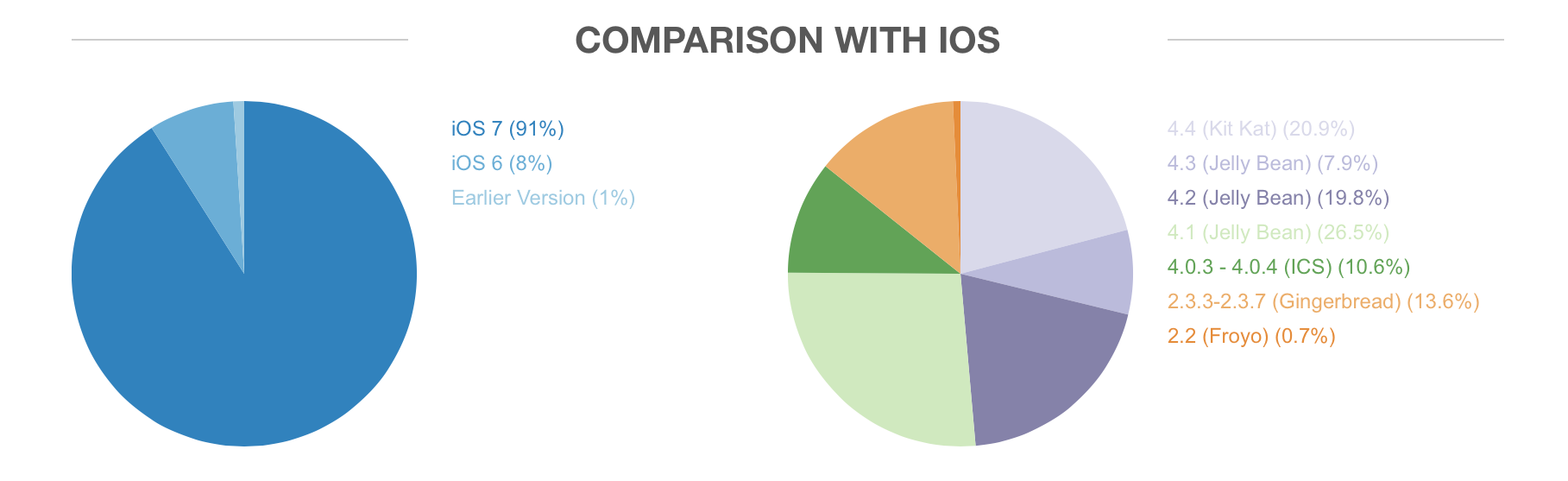
Android fragmentation runs amok, while 91 percent now use iOS 7


In July,
I purchased my first Android-based device, the LG G3. Soon after, a
friend with a Samsung Galaxy Mega attempted to duplicate a feature he
had seen while testing my handset. He couldn’t because his phone had a
different build of Android installed. To make matters worse, the phone
couldn’t be upgraded to the newer version because Samsung wouldn’t allow
it.


Welcome to the world of Android fragmentation, which has grown in recent months, according to OpenSignal.


To date, there have been 18,796 distinct Android-based devices seen
in 2014. Of those, 43 percent are Samsung devices. In total, just 20.9
percent of devices have the latest version of Android installed, KitKat.
This compares to the 91 percent who use iOS 7.


Screen 2
OpenSignal notes that Android fragmentation can be “extremely
challenging and time-consuming” to developers. They also say it has a
“great number of benefits,” noting that “The availability of cheap
Android phones (rarely running the most recent version) means that they
have a much greater global reach than iOS, so app developers have a
wider audience to build for.”


I don’t agree. Unofficially, Apple guarantees that an iPhone or iPad
purchased today will be able to run the latest version of iOS for three
years. As my friend found out, being on the latest version of Android is
sometimes not even an option — even for a relatively new device. The
first-generation Samsung Galaxy Mega arrived in April 2013. His was
purchased in February of this year.


What’s beneficial about that?
 -- AppAdvice

Saturday, July 26, 2014

You can now unlock your Motorola phone with a 'digital tattoo'

Hate unlocking your Android smartphone so much that even Face Unlock or Skip feels like too much of a hassle? Motorola just came to your rescue. The company has partnered with VivaLnk to launch the previously teased Digital Tattoo, an NFC-based skin tag that unlocks your phone (currently limited to the Moto X)
with a quick tap. The tattoo can stay on your body for up to five days,
and it should survive abuses like showers and sweat-laden runs. It's a
clever approach that might be appealing if you're fed up with PIN codes
and patterns, although the back-of-a-napkin math suggests that you're
paying a lot just to save a couple of seconds when checking your email.
VivaLnk is asking $10 for packs of 10 tattoos, or enough to last 50 days
-- you'll have to spend $80 to get through a whole year. It could be
useful for those busy days when you're constantly waking up your
handset, but you might be better off rolling that money into a Moto 360 or your next big phone upgrade.

Saturday, July 19, 2014

Week 28 in review: LG G3 S and Lumia Cyan update

The Week In Review is our series meant to recap all the major
announcements of the week, which you might have missed. Week 28 of 2014
wasn't as busy as the past few weeks, but it still brought us some cool
hardware and brought news of several major software updates.

The long rumored affordable flavor of the LG G3 flagship was made official this week. It is called LG G3 Beat
in the Asian markets and LG G3 S for the EU and CIS regions. The LG G3
Beat packs a 5" IPS HD display, runs on Snapdragon 400 chipset and
features an 8MP camera with laser-assisted auto-focus.


The design and software package remain identical with the LG G3,
while dual-SIM version will become available too. The LG G3 Beat is
already selling in South Korea, while it will hit the shelves soon in Europe at €349.


The owners of Windows Phone 8-based Nokia Lumia smartphones around
the world got a nice present to kick off their summer. The entire WP8
Lumia range, including the carrier-exclusive models, are now getting the
Lumia Cyan update with the latest Windows Phone 8.1 OS.
It brings a plethora of new features and services, and everyone will be
happy to upgrade. The rollout is gradual, but hopefully everyone will
be running on Windows Phone 8.1 soon enough.

The Nokia X lineup wasn't as lucky though. Microsoft has decided to pull the plug on the project
and will lay off 18,000 workers throughout the next six months. It will
continue to support and sell the Nokia X and X2 and they will receive
more updates in the future, although we are doubtful many will be keen
on getting them now.

Microsoft CEO
Three Android 4.4.2 KitKat updates began seeding this week. The lucky devices are Samsung Galaxy Grand 2, Samsung Galaxy S4 Zoom and Sony Xperia T2 Ultra.


The Sony's firmware also includes an option to move apps to the SD card, which is really nice. Meanwhile HTC has begun rolling out HTC Sense 6.0 update for the original HTC One mini.

We also learned BlackBerry is readying its own virtual assistant and it will be installed on the BB10 devices with the next BB 10.3 update. Better late than never, we guess.


BlackBerry Assistant (click to enlarge)

This week gave us a glimpse over the upcoming Huawei's Emotion 3.0 UI. It looks a lot like the iOS 7, but there is no word on its device availability yet.

Huawei Emotion UI 3.0

MediaTek has finally unveiled its anticipated MT6795 chipset
with octa-core 64-bit processor and LTE support. It supports 2K
displays, 120Hz screens, 1080p @480fps video recording and playback,
among others.

Apple iPhone 6 was in the news pretty much every day, as expected. First Amazon Japan confirmed its dimensions and availability. Then we heard news Apple is experiencing issues with the bigger 5.5" model and might not release it this year. The iPhone 6 is also tipped to come with an improved TouchID sensor, and while we knew already about the sapphire display, it may not be spread over all iPhone models. Finally, the case maker Spigen spilled the beans on the iPhone 6 design via a case listing.

Meanwhile Apple announced a partnership with IBM, which will target the enterprise market. You can learn more about the subject in our news.


Wednesday, July 16, 2014

360 Clean Droid runs circles among Android smartphone optimization apps


Android optimization apps are dime-a-dozen. What makes 360 Clean Droid special? To be perfectly honest, it's the interface. A graduate from the "one-click-functionality" school, the app is all about big letters, rounded buttons, and plenty of color is what this one is about. An optimization app can't really be simpler and friendlier to use.


We talked form, let's talk function now. First, the app boasts "millisecond boosting technology", which is 'fancy speak' for its ability to execute all its optimization programs with a single tap. Second, 360 Clean Droid features "advanced trash cleanup". We're not completely sure what makes it so advanced compared to other algorithms, but nevertheless, it's going to free plenty of space on your phone that you probably didn't know you had. Finally, the app has a "privacy protection" module, which lets you erase web history, traces of other apps, text message history and phone call logs, and other stuff you don't want to display in public. 


To top it all off, 360 Clean Droid has an "Autostarts Manager", which lets you disable specific apps from starting upon your device's boot. There's also a "Bloatware Uninstaller", which counts the number of pre-installed apps your smartphone or tab comes from and puts it against the number of apps you voluntarily installed. Needless to say, you can proceed to uninstall most of them, although this functionality expects your device to be rooted.


All told, if you are looking for a reasonably well-featured and good-looking Android optimization app, try 360 Clean Droid. You don't have anything to lose.

Tuesday, July 15, 2014

Samsung Galaxy Tab S: One big blemish mars great Android tablet


Review: Samsung Galaxy Tab S
Samsung's been on a downslide lately when it comes to its hardware designs. The nice-looking Galaxy S 4 was followed by the plasticky Galaxy S5, and while the various Galaxy Note and Galaxy Tab tablets have not been ugly, neither have they been pretty. Samsung's last high-profile tablet, the 12-inch Galaxy Note Pro, turned out to be an awkward device that no one talks about any more.
So it was a nice surprise to get my hands on Samsung's new Galaxy Tab S. The admittedly iPad-like casing is very attractive, adding up to the first elegant Android tablet. (The HTC One achieved elegance for Android smartphones a year ago.) The screen is simply gorgeous, dispelling my fears that its amped-up, "Miami Vice"-like colors would feel unnatural. Even the tiny speakers have rich sound.
[ Review: iPad Air and Retina iPad Mini won't knock your socks off. | Media tablet showdown: Retina iPad Mini faces newly beefed-up challengers. | Keep up on key mobile developments and insights with the Mobilize newsletter. ]
Review: Samsung Galaxy Tab S
A useless fingerprint sensorWith one big exception, the Samsung Galaxy Tab S is the ideal Android tablet today. That exception is its fingerprint sensor, which works terribly. Apple's iPhone 5s Touch ID fingerprint sensor shows how such technology should work: You rest your finger briefly on a sensor pad to unlock the device or authorize a transaction. You can also teach it to use more than one finger.
Unfortunately, Samsung rushed its fingerprint-sensing effort in an obvious attempt to clone an Apple feature without doing it right. Remember those PCs a decade ago that had a sensor bar you could slide your finger across to unlock them? That's how the Galaxy Tab S's fingerprint sensor works: You slide your finger across the Home button. (And it recognizes only one finger.)
But that old-school technology almost never reads the fingerprint, rendering the feature useless on the Galaxy Tab S. You'll need to keep using a manually entered password -- sadly, a faster method. By contrast, the iPhone 5s's fingerprint sensor is so fast and accurate that you'll likely forget your password with repeated use.
A beautifully intense screenSamsung has long tended to oversaturate its screens' colors, creating a cartoonish color palette that draws your gaze but can feel unnatural. The Galaxy Tab S amps up that already aggressive palette, but somehow it doesn't feel garish. Instead, it feels vibrant and intense in an appealing way.
But the rest of Samsung's claims about its SuperAMOLED screens' superiority versus the iPad's are untrue. First, the Galaxy Tab S has a decidedly bluish color cast, so text is a bit harder to read than on the iPad's true-white display. Of course, that bluish tinge amps up the overall color palette, so a Galaxy Tab S's games and photos feel more intense than on an iPad. The iPad's screen is better for reading, while the Galaxy Tab S's display is more suited for graphical apps.

Huawei Ascend P7 review: the best mid-range phone you've never heard of

Huawei Ascend P7 review: the best mid-range phone you've never heard of
What is a flagship? For some companies, it's about cramming as many features into a device as physics allows. For Huawei, it means something else entirely: Though it creates smartphones for the power-hungry crowd, its most eye-catching devices typically favor mass appeal over brawn. Exhibit A: the Ascend P7, a smartphone that emphasizes design and user-friendliness over a blowsy spec sheet. When we reviewed its predecessor, the P6, last year, we found a gorgeous phone that struggled due to an underpowered engine and lack of LTE. The company promises it's learned from its mistakes, though. So is the P7 the mid-range smartphone you'll actually be proud to show off?

Huawei Ascend P7 review

See all photos
13 Photos

Hardware

Before we begin, we have to address the 800-pound gorilla in the room, and we're not just talking about the type of glass that coats both sides of the device. The P7 looks like the result of gene splicing between the iPhone 4 and one of Sony's Z-series handsets. That's not meant to be a criticism, but the lens placement and machining scream Xperia, while the plastic dividers that separate parts of the aluminum band are there entirely for effect.

Similarities aside, it's a beautiful piece of equipment and you'll have total confidence in the solidity of this device when it's in your hand. Huawei's got a knack for putting smartphones together and there's no worry that this kit will creak or bend. It's also tremendously easy on the pocket, since it's only 6.5mm thick and weighs a light 124 grams (4.37 ounces). Rest assured that despite being more than £200 cheaper than the Galaxy S5 here in the UK, it's also a good-looking phone, so you needn't be worried that the posher kids at school/the office/the pub will sneer at your cheaper device. In fact, this would happily sit beside flagships from Samsung and HTC without appearing like the dowdy friend who you only sit with under duress.
I'm conflicted on the subject of comfort. This is because the P7 is a great, big, boxy piece of hardware with squared-off edges. Despite this, at no point did it jab into the flesh of my hand or otherwise make my life uncomfortable. I can't imagine delicate hands disliking the feel of this device, but I'm also aware that my mileage will differ from yours. What is consistent is that the glass backing makes this more of a slip risk than more tactile devices, so if you've got greasy palms and a tendency to be clumsy, buy a case.

If minimalism is your bag, then you'll find the understated lines of the P7 right up your street. Up front are the speaker, light sensor and the 8-megapixel forward-facing camera, all of which linger above the display. On the bottom, there's a micro-USB port for charging, with the 3.5mm headphone jack located up top. The left-hand side is bare, so the right has to hold the micro-SIM and microSD trays, as well as the center-mounted power button -- another Xperia-esque trait. All three are metal, and there's some beautiful machining on the center button -- a high-quality detail from a company you wouldn't always associate with small, design-centric flourishes.

Display and sound

The 5-inch, in-cell LCD from Japan Display really doesn't look as big as it is, thanks to bezels that have been shrunk down to just 3mm. With a resolution of 1,920 x 1,080 (that's FHD, acronym fans) and a pixel density of 445 ppi, it sits in the same league as the Nexus 5, which means we have little to complain about. Pictures and video are crisp; the viewing angles are almost universally good; and it'll hold its own in the noonday sun, even when not on full brightness. Color accuracy is acceptable, although in side-by-side tests with another device, everything looked a little over-saturated. Not enough to annoy most users, though. The company has also retained its so-called gloves mode, which ups the sensitivity on the screen making it possible to use when you're out in the cold.
One particular bugbear of mine is when smartphone manufacturers place the speaker close to where you hold the device. It's been more than a year since HTC demonstrated front-facing speakers are the way forward, so why do companies insist upon this retrograde step? Unfortunately for me, Huawei has stuck the speaker right in the path of my palm, though it's at least made the placement work to its advantage. Thanks to the vertical orientation of the speaker, the curve of your hand may actually make a funnel to amplify the sound, no matter which one you hold it with. The volume is strong up close, but won't fill a room if you're hosting an impromptu dance party. That's not a criticism either, since it means that berks who forget their headphones on public transport will only annoy the people in their immediate vicinity. Small mercies, eh?

Software

The P7 runs Android 4.4, but you wouldn't know it just by glancing at the screen. As ever, Huawei included its proprietary Emotion UI skin, with this particular device running version 2.3 of the software. The first thing die-hard Droid fans are going to notice is that there's no app tray. Huawei and I share the same annoyance with Android's two-stage launcher, so all apps now reside on the multiple pages of the home screen -- yep, just like on iOS. In order to prevent the phone from becoming unnecessarily cluttered, the company crams several of the smaller utilities into folders. That's fine, but don't be surprised if you have to do a little shunting around to get things the way you like it.

Huawei Ascend P7 screenshots

See all photos
17 Photos
The landing screen comes preloaded with weather, music, gallery and Google search widgets, all of which are easily dispatched. The "Me" module, which offers up instant access to a favorite contact or two, is largely useless and, thankfully, easy to get rid of. The other upside is that there's a wide variety of customization options, and you can tweak the icons and environment to suit any number of tastes. There's also the option to add a suspend button -- a ring of shortcuts that hovers over the screen, offering instant access to utilities such as note-taking, messaging and music playback.

Buried within the settings menu is Simple, a home screen style that transforms the ordinary Android environment into something more akin to Windows Phone. The company's been offering the setting since the start of the year, but this is the first time I've actually been able to sit down and see what it's like up close. It's certainly a clever way to present this phone to those who may not have as good eyesight or not much familiarity with smartphones in general, but the small icons and text -- there's a lot of blank space on each button -- make me wonder if bigger text and icons wouldn't have done a better job. Unfortunately, these shortcuts only work for launching apps themselves, after which you're just using standard apps with the text blown up.

Camera

Imaging is one area where Huawei has, at least on paper, splashed the cash. Rather than attempting to craft a solution on its own, the company sought out Sony to provide the 13-megapixel sensor used in the P7. Even better, the forward-facing camera now boasts an 8-megapixel sensor, besting both the HTC One M8 (five megapixels) and the Galaxy S5 (2MP). The primary unit is much improved, and the over-saturation we found in last year's model has been dialed down somewhat. There's a pleasing depth to the images now, and I was happily snapping stills and landscapes in the summer sun. In the late-evening gloom, however, photos got a little too murky to be useful, and at night, the images were decent, but tremendously noisy. As the company works on the inevitable Ascend P8, we hope that instead of just throwing in more megapixels, Huawei improves the hardware as well.
Whenever you use a forward-facing camera that doesn't take grainy, blocky selfies, it's a moment of triumph, and even an unattractive curmudgeon like me enjoyed snapping some vanity shots with the P7. The forward-facing unit here is a great piece of kit, and should set the standard for all of those duckface-obsessed teenagers who want to show off how much of a good time they're having on holiday. Speaking of which...
T-shirt: AOL; Coat: Red Herring; Face: Model's Own.
In this world of artifice and constructed reality, everyone wants to be their best when they post braggies (bragging selfies) online. That's why Huawei includes "Face Beauty Mode" as one of the options for the forward-facing camera. With the ability to detect one face in the frame, the P7 will get out the digital Vaseline and smooth out the wrinkles, blocked pores and creases in your face. The only downside is that at a certain point, the effect rapidly begins to backfire, and if you posted a picture of your mug at Beauty Level 10, we're sure people would start calling you to check you weren't ill. Surely those Dove ads have taught us all that natural beauty is the way forward, right?
What of the Huawei Ascend P7's video performance? There's nothing wrong with the images, per se, and we can even forgive the accelerometer issue that caused footage recorded in landscape to occasionally save in portrait. Audio, however, is an entirely different, and painful, story. The P7's microphone manages to be both far too weak and far too sensitive. When the subject is mere inches away from the phone, the audio appears to be piped in from some faraway land. Despite this, the microphone just adores wind shear, and even on an almost entirely still summer day, the footage sounded as if I'd been filming it in a gale. Suspecting that those flaws would make it an ideal device to record indoor gigs with, I took the P7 to see The Brian Jonestown Massacre, and even standing at the back of the auditorium, the audio simply couldn't handle the noise. Instead, it made everything sound as if the handset had been left in a box of dry cereal during an earthquake.

Performance and battery life

HUAWEI ASCEND P7HTC ONE M8LG G3
Quadrant 2.07,17525,54825,548
Vellamo 2.01,1411,8041.405
3DMark IS Unlimited746220,61216,662
SunSpider 1.0.21,239.7782918
GFXBench 3.0 Manhattan Offscreen (fps)N/A11.2N/A
CF-Bench30,10840,22324,667
SunSpider: Lower scores are better.
The subtitle for our Huawei P6 review read "a beautiful handset, but performance is lacking." That's because that handset came with a Huawei-made 1.5GHz quad-core CPU, which, while affordable, wasn't up to the task of running a flagship smartphone. The company says it's learned its lesson, and promises that the tablet-class, 1.8GHz quad-core CPU, Mali-450 GPU and 2GB RAM on show here would be up to the task. This new silicon even boasts HPM technology -- in short, a system designed to offer lower power consumption for demanding applications. As you can see above, however, this new hardware still isn't enough to get the P7's head above its rivals in the benchmark stakes. In fact, in an industry where standing still is equivalent to going backward, the fact that this phone is so far behind its rivals is going to turn off many people who would otherwise consider giving the P7 a shot.

But.

Benchmarks do not tell the whole story, and day-to-day, this apparent weakness was in no way noticeable. Tweeting, making calls, surfing the internet, dicking around on Instagram and watching video were all undertaken with only the odd flicker and stutter to mention. I did find that if I wanted to launch the camera app from a standing start (e.g., from the lock screen), the action didn't keep up with the graphic reorientation as I switched the phone from portrait to landscape mode. The result was that everything would freeze for a second while the software caught up, which meant that I missed a few action shots I would have otherwise been able to take. The biggest test, of course, is in games performance, and graphically intensive 3D titles like Asphalt 8 worked like a dream. The only issue I found was that it took a few loads (and a hard restart) before Dead Trigger 2 would play, but once it did, it was buttery smooth.

So what of the battery life? In Engadget's standard video-rundown test, I managed to crank out a respectable seven hours and 12 minutes from the handset's 2,500mAh power pack. At least, it's respectable if you're contented to compare this with handsets in the same price bracket, such as the HTC One mini and the Galaxy S4 Mini, but more on that later. Over the course of a day with light to normal use, we were finding that it still had around 20 percent of charge remaining to it.

The other thing we need to talk about is the data rate, and unfortunately, while Norwich has a thriving arts scene, beautiful landscape and a fast train to London, Three have yet to offer LTE in the city. That's why I was instead only able to test the P7's 3G performance, which hit 6.62 Mbps down and 1.10 Mbps up. The next time I'm in an LTE area, I shall update this section with my findings. Call quality is perfectly fine, in case you were wondering, not that anyone uses their phones as phones anymore.

The competition

As I benchmarked the P7 and tried to assess its performance, I thought about which phones I should be comparing this device with. On one hand, Huawei, would position this as a significantly cheaper alternative to the HTC One M8 and Samsung Galaxy S5. Unfortunately, at least in the UK, no carriers have announced that they'll be offering the handset, and so we can only look at it in the context of its SIM-free price, which is £330. For around that same amount of cash, you can also buy the Galaxy S4 Mini (£330), the Huawei Ascend Mate(£330) or the first-generation HTC One mini for £320. (Yes, I know the replacement is called the HTC One mini 2, but let's avoid confusion.)

Wrap-up

In a money-is-no-object world, every smartphone would come with a Snapdragon 805, a 41-megapixel camera, a beautiful body and a 4K display. Huawei's aim here was to build a device that could be spoken of in the same breath as the Galaxy S5 and HTC One M8 at a significantly reduced cost. And it succeeded with a handset that is more than the sum of its parts. Huawei wins points for the rock-solid build quality, the materials used and the overall aesthetic. The imaging prowess of both the forward- and rear-facing cameras is better than you may expect from a handset that's priced well within the second tier. That's another merit, since at £330, the Ascend P7 is about £220 cheaper than the Galaxy S5 -- enough money to buy a first-generation Android Weardevice and still have enough money left over for a meal. If you're prepared to accept a few rough edges here and there, the Ascend P7 is a worthy recipient of your hard-earned cash.
Huawei

Ascend P7

Conclusion
With the P7, Huawei has crafted a phone that defies its modest price tag. It may not be as powerful as other flagships, but it's better than other handsets that cost about the same.

HTC loses two top executives

The company's chief marketing officer and its president of engineering and operations have resigned, according to Bloomberg.
htc-one-red-three-angles.jpg
The HTC One
Smartphone maker HTC, which has watched its revenue slide and competition mount, is losing two executives, according to Bloomberg.
HTC Chief Marketing Officer Ben Ho has resigned and will be replaced by CEO Cher Wang, Bloomberg reported Tuesday, citing people who claim to have knowledge of the situation. Meanwhile, HTC president of engineering and operations, Fred Liu, has also resigned. Liu's departure appears to be a retirement, according to Bloomberg's sources, and he will stay on through the end of the year while his replacement is found.
Taiwan-based HTC's revenue has slid for the last 11 consecutive quarters. Although it is offering one of the better Android-based smartphones on the market, the HTC One M8, the company is still having trouble nabbing significant market share.
Wang, who co-founded the company in 1997, briefly stepped away from the firm when things were going well. However, she came back to the company last year to take on a more active role. Wang believes that the right mix of product quality and executives could help the company change its luck.
HTC has not publicly announce the resignation of the two executives. CNET has contacted HTC for comment and will update this story when we have more information.

Monday, July 14, 2014

HTC W8, HTC Eye and others mentioned in Dot View compatibility document

Earlier this year, when HTC announced its One M8 flagship smartphone, it also unveiled a brand new and interesting case called Dot View (pictured on the left). At the moment, Dot View is compatible only with the One M8, but it looks like it’s coming to more HTC devices. And while that may not be too interesting, the handsets that are reportedly compatible with the Dot View case are certainly newsworthy.


According to an image posted by @evleaks, the “Dot View Premium” case is compatible with the following devices: M8, M8 Ace (which is, in fact, the already-announced One E8), B2, W8, and Eye. The existence of the last three handsets hasn’t been confirmed by HTC, but we heard that the W8 could be the company’s first Windows Phone 8.1 product, while the HTC Eye is supposed to be an Android-based “selfie phone.” As for the B2, this could be a new HTC Butterfly.


Also

HTC W8, HTC Eye and others mentioned in Dot View compatibility document
mentioned are a “Dot View Standard” that’s compatible with an unknown A51, and a “Dot View Lite” that should work with HTC A21 and HTC A11 (both of which are unknown devices as well).


Assuming that this Dot View compatibility list is legit, we’re expecting HTC to announce the W8, the B2 and the Eye in the near future. Plus, of course, those mysterious A51, A21 and A11 may also make an official appearance.

So, are you looking forward to seeing HTC's first WP 8.1 handset? What about the Eye "selfie phone", or the next-generation Butterfly? Let us know in the comments below.


Sample text

Sample Text

Sample Text