Social Icons

Showing posts with label samsung. Show all posts

Monday, March 09, 2015

Samsung Galaxy S5 vs S6 comparison: What's new in the Galaxy S6

Samsung Galaxy S5 vs S6 comparison: What's new in the Samsung Galaxy S6


Samsung's Galaxy S6 is expected to be announced at this
year's MWC, but how does it differ to the current Samsung Galaxy S5? We
compare what we know about the S5 and what we think we know about the S6
to find out. It's S5 vs S6.


For more information read our full Samsung Galaxy S5 review and Samsung Galaxy S6 UK release date, price and specs: when is the Samsung Galaxy S6 coming out?


We should point out that the Samsung Galaxy S6's specification has
not yet been confirmed, but many details have leaked. We will update
this article once new information is available. Note that the imaghes
used here are of the Samsung Galaxy S5. Also see: Best phones 2015 and best new phones coming in 2015.


Samsung Galaxy S5 vs S6 comparison: Price and UK availability 

When the Samsung Galaxy S5 was announced it had an RRP of £579, but
even before its release it was reduced to around £550, and within a
month or two, £500. A year later and the Samsung Galaxy S5 costs £383
SIM-free at Amazon.


We expect to see exactly the same pattern with the Samsung Galaxy S6,
so you may find that it will pay to wait a month or two following its
March release before you buy.


Samsung Galaxy S5 vs S6 comparison: Design and build 

The Samsung Galaxy S5 is a plastic hanset with a removable rear cover
that has a perforated texture, supposedly in order to feel more natural
and aid grip in the hand. It's a removable cover, allowing access the
also removable battery and microSDXC slot.


With the Samsung Galaxy S6 expect to see a more premium looking
design with a metal chassis. The removable cover will still be plastic
and removable, but the overall design will look more similar to the Samsung Galaxy Alpha.


The screen will mark a key difference between these two smartphones,
if rumours are correct. While the Samsung Galaxy S5 packs a 5.1in
full-HD (1920x1080, 432ppi) display, the S6 is expected to get a 5.5in
Quad-HD (1440x2560, 534ppi) panel. Both will use a Super AMOLED screen,
so the only differences will be in their size and resolution. Expect it
to be protected with Gorilla Glass 4, rather than the S5's Gorilla Glass
3, too.


All the screen software tweaks built into the S5, such as Smart stay and Adapt display, should also be found in the Galaxy S6.


Given the larger screen it's possible that we may see a slight
increase in size and weight over the Samsung Galaxy S5's 142x72.5x8.1mm
and 145g, yet the S6 is rumoured to come with slimmer bezels.


As with the S5, the S6 will include a heart-rate monitor on the rear,
plus a fingerprint scanner built into the Home button - but this one
should be more intuitive to use, with touch- rather than swipe-based
input. Like the Samsung Galaxy Note 4 it
will also get a UV sensor. Leaked case designs, which may or may not be
accurate, suggest the dual-LED flash will be moved to the other side of
the camera.


One other rumoured change is that the Samsung Galaxy S6 will no
longer support IP67 dust- and waterproof protection. However, the source
of this claim says that's because there will also be an Active version
of the S6, yet we also saw an Active version of the S5.


In common with the Samsung Galaxy Note 4, the Galaxy S6 will be
available in two versions: the standard Samsung Galaxy S6, plus the Galaxy S6 Edge. This will be similar to the Galaxy Note Edge,
which has a curved edge to one side of the screen to show notifications
and the like, except this handset may offer two curved screen edges.


The Samsung Galaxy S6 is expected to be available in Charcoal Black,
Copper Gold, Electric Blue and Shimmery White, matching the options
available with the Samsung Galaxy S5.


Samsung Galaxy S5 vs S6 comparison: Hardware and performance 

Originally thought to come with a Qualcomm Snapdragon 810 chip in the
UK, fears over overheating issues have reportedly led Samsung to
reconsider and fit the Galaxy S6 with its own Exynos 7420, a 64-bit
octa-core processor with four Cortex-A53 cores and four Cortex-A57s.
This has seemingly been backed up by the fact that in its latest
earnings call Qualcomm admitted it had lost a big client.


This Exynos 7420 chip may also be backed up with 3GB of RAM and 32-,
64- and 128GB storage models, although we doubt we'll see any more than
32GB in the UK. You will also be able to add microSD cards up to 128GB
in capacity, of course.


By comparison, in the UK the Samsung Galaxy S5 has a 2.5GHz Qualcomm
Snapdragon 801 processor, Adreno 330 graphics, 2GB of RAM and 16GB (or
apparently 32GB) of storage with the same microSD support. It performs
very well in our benchmarks, netting 2869 points in Geekbench 3.0
multicore, 824ms in SunSpider, and 28fps in GFXBench 3.0 T-Rex. We don't
know exactly how much faster the S6 will prove to be, but we do expect a
significant performance bump. Also see: What's the fastest smartphone 2015?


Samsung Galaxy S5 vs S6 comparison: Audio 

Sound quality in the S5 is acceptable, but nothing out of the
ordinary. However, Samsung's hoping to appeal to audiophiles with its
upcoming Galaxy S6 if reports are to be believed. It's thought to come
with Sennheiser uni-directional earbuds, which look similar to Apple
EarPods. Rumour has it they will feature apt-X, which may mean they are
wireless.


Samsung Galaxy S5 vs S6 comparison: Cameras 

One area in which there have been contrasting rumours is photography.
While all sources seem to confirm the S6 will get a 5Mp front-facing
camera, boosted from the S5's 2Mp and appealing for use in video chat
and selfies, no-one seems to be able to make up their mind as to whether
it will stick with the S5's 16Mp camera, with optical image
stabilisation as seen on the Note 4, or upgrade it to 20Mp. This is one
area in which we will have to wait and see.


Expect at very least everything you get with the S5, Note 4 and
Galaxy Alpha, however. That means 4K UHD video at 30fps, plus all
Samsung's software tweaks, including real-time HDR, Beauty Face, Dual
Camera, Panorama, Selective Focus, Shot & More and Virtual Tour.


Samsung Galaxy S5 vs S6 comparison: Connectivity 

We're not expecting much to change on the connectivity front,
although it wouldn't be unreasonable to think Samsung might improve the
S6's LTE support. In S5 and S6 you'll get 4G LTE, Bluetooth 4.0, GPS,
NFC and dual-band 802.11ac Wi-Fi. In the S5 Samsung also specifies MIMO
technology and offers a unique Download Booster that combines the power
of 4G LTE and 802.11ac Wi-Fi to deliver downloads at a theoretical max
of 400Mb/s, so expect to find these in the S6 too.


Samsung Galaxy S5 vs S6 comparison: Software 

While the Samsung Galaxy S5 is sold running Android KitKat, the S6
will come with Lollipop. You can read up on the key differences in our Android KitKat vs Android Lollipop review, but keep in mind that Samsung will also upgrade its S5 to Lollipop.


TouchWiz features on both S5 and S6, but in the S6 Samsung is
expected to slim down its preinstalled offerings with much of it
available as free downloads. We're sure you'll still find S Health, S
Voice, the Galaxy Apps store and its Magazine BlinkFeed-style UI at the
very least.


The Samsung Galaxy S6 is also expected to offer enhanced themes, with
a Themes Center letting you change system sounds, fonts and Events
(such as Christmas or Valentine's Day). There will also be a Themes
Store.


Samsung Galaxy S5 vs S6 comparison: What's new in the Samsung Galaxy S6


Samsung Galaxy S5 vs S6 comparison: Battery life 

The Samsung Galaxy has a 2800mAh removable battery and an Ultra Power
Saving mode that ekes out every bit of life (up to 24 hours) from the
last 10 percent of juice by turning off all unneccessary functions and
using a greyscale display. The S6's battery capacity has not leaked, but
we do know that it will support the same Ultra Power Saving mode plus
fast charging - in the Galaxy Note 4 the battery can go from zero to 50
percent in just 30 minutes, which is twice as fast as most phones, and
something we hope to see in the S6.


Samsung Galaxy S5 vs S6 comparison: Verdict

We're going to hold off our verdict until we've seen the finished
Samsung Galaxy S6, but from the sounds of it Samsung has made a lot of
improvements - the Quad-HD screen alone would make it a worthwhile
upgrade over the S5.

 - PC Advisor

Saturday, March 07, 2015

Samsung Galaxy Alpha review: Samsung's most beautiful phone yet


When a company names one of their products after the first letter of
the Greek alphabet, it means business. Take Samsung's Galaxy Alpha: The
name alone exudes confidence. Although the term typically signifies the
first in a series, the Alpha obviously isn't Samsung's inaugural Android
phone; rather, it ushers in a completely new design direction for the
company. It's not a top-of-the-line flagship device on the inside, but
what matters is that it actually looks like one on the outside,
thanks to its premium aesthetics, metal frame and sleek body. Samsung
has every reason to be confident in the Alpha's design. As always,
however, there's more to a device than meets the eye.

Gallery

25 Photos

Samsung Galaxy Alpha review


Samsung

Galaxy Alpha

Summary
The Alpha is Samsung's first phone with a metal frame, and it's the
most aesthetically pleasing Galaxy phone we've ever seen.
Unfortunately, it's priced at a premium and doesn't have the same set of
features that you can get on the Galaxy S5 for the same price.


Hardware

The Galaxy Alpha is the most beautiful Samsung device I've ever
handled. It's the very first device to take advantage of the company's
brand-new design language, which features polished aluminum sides,
chamfered edges, a thin profile and a polycarbonate (plastic) back; the
same design is used on the Galaxy Note 4 and Galaxy Note Edge (and
arguably, the iPhone 5/5s and last year's HTC One), but the Alpha is the
first to actually make it off the production line. It's simple, yet
elegant; minimal, yet profuse. Featuring a 4.7-inch frame and 6.7mm
thickness, the Alpha is more than sufficiently sleek and svelte.


Thanks to its slim, compact frame, I had absolutely no problem
hanging onto the Alpha. Not only can I wrap my hand around the whole
thing, but also its straight sides offer my fingers plenty of space to
grip. It's also incredibly light, weighing 4.06 ounces (115g); that's
half an ounce lighter than the iPhone 6. In fact, it almost feels like
it isn't substantial enough; in my palms, I'm often reminded of a dummy phone -- fake versions of the real thing that manufacturers send to retail stores.


I'd be tempted to think of the Galaxy Alpha as a GS5 mini, if the
name weren't already taken; in many respects, it's a smaller version of
Samsung's current 5.1-inch flagship smartphone. It packs the same
Snapdragon 801 chipset (though an Exynos option is also available in
certain markets), so it should be similarly powerful, and it also comes
with a fingerprint scanner, heart rate monitor and Samsung's TouchWiz
UI. But while the Alpha easily beats the GS5 in style (while matching it
in oomph), the rest of the spec sheet isn't as impressive. It's not
waterproof; it lacks a microSD slot; the battery is smaller; it uses a
lower-res camera; and it doesn't come with an IR blaster. It also
features a lower-res 720p Super AMOLED display.


Since it's not designed to simply be a miniature GS5, these omissions
theoretically shouldn't be a big issue. It still packs plenty of a
punch, after all, and even the 720p display is considered
top-of-the-line for similarly sized devices. (Also, with smaller phones,
manufacturers don't have as much space to cram in extra components.)
The problem is that you're paying a premium price for the premium look;
you can get the Alpha on AT&T in the US for $200 on-contract, or
$613 with no contract attached. This is the same on-contract price as
the GS5, and only $37 cheaper at full retail. To be fair, AT&T's
Galaxy S5 only comes with 16GB internal storage, whereas the Alpha gets
32GB, so that explains some of the difference. Even so, the GS5 at least
has a microSD slot for expandable memory.


What's even weirder is that while the Alpha doesn't come with any waterproofing or water-resistance of any kind, iFixit
did a teardown of the phone and discovered that it comes with many of
the gaskets and other internal parts necessary for keeping water out. In
other words, Samsung didn't finish what it started.


The bottom edge of the device houses a micro-USB 2.0 connector --
Samsung's moved away from the unsightly 3.0 ports that take up extra
room -- along with a speaker grille and mic. On the left is a volume
rocker, which appears to have received the same amount of attention to
design as the rest of the phone. There's a 3.5mm headphone jack on top
and a power button on the right. Additionally, the top and bottom of the
phone feature a pair of antenna stripes, which are common on metal
phones because they provide a place to send and receive cellular and
wireless signals.


The Alpha also comes with a removable back cover with a textured
polycarbonate back that's similar to what you'll find on the Galaxy S5.
On the Alpha, however, the dimples are much tinier and the matte surface
doesn't feel as slick; the Alpha definitely offers more friction.
There's a 12-megapixel camera in the top-center, and since the module is
thicker than the phone itself, there's a hump to make the transition
between the camera and back cover seem a bit more gradual. (One of my
biggest issues with the iPhone 6's design is that the camera abruptly
sticks out from the rest of the frame.) The LED flash and heart rate
monitor are to the camera's left, arranged in a vertical fashion, and
the logos include just the AT&T globe near the top and the phone's
name near the bottom. Underneath the back cover, you'll find a removable
1,860mAh battery and nano-SIM slot.


The new location of the heart rate monitor works out okay if you hold
the phone in your right hand, but it can be troublesome if you prefer
your left; the camera hump gets in the way, and I had to keep looking at
my finger to make sure it was in the right place. Which brings me to
another point: The Galaxy S5's sensor was placed at the bottom of a
cavity, while the Alpha's version is nearly flush with the rest of the
back. This makes it more difficult to find the sensor without peeking
around the phone to make sure I'm actually in the right spot.


An aluminum frame comes with trade-offs. Sure, it looks great, feels
robust and has an aura of high quality, but as I saw with the iPhone 6,
the material isn't immune to blemishes; after just a few days, I started
seeing scratches and even a couple dings along the chamfered edges.
This means that how it looks after a year of use will depend on how you
treat it. If it's constantly rubbing up against other hard materials,
it's not going to fare well.


As mentioned earlier, the Alpha has a 4.7-inch 720p Super AMOLED
panel. On paper, this doesn't sound very good since many new flagships
have Quad HD displays. For a handset of its size, however, 720p is still
acceptable: The first Moto X was of the same quality. Ditto for the
Sony Xperia Z3 Compact, which is one-tenth of an inch smaller. The
iPhone 6, meanwhile, is slightly better at 1,334 x 750 (326 pixels per
inch). With the Alpha, you'll get a pixel density of 312 ppi, which is
still respectable. Of course, the Super AMOLED panel ensures that colors
are more saturated than most IPS options, and the viewing angles are
simply average and nothing special. If you're looking for a compact
phone, the display will neither make nor break the decision for you --
it's perfectly fine, as long as you don't mind some slightly inaccurate
colors.


Samsung Galaxy Alpha Apple iPhone 6
Pricing $200 (on-contract), $613 (off-contract) Starts at $200 (on-contract); $650 (off-contract)
Dimensions 132.4 x 65.5 x 6.7 mm (5.21 x 2.58 x 0.26 in) 138.1 x 67 x 6.9 mm (5.44 x 2.64 x 0.27 in)
Weight 115 g (4.06 oz) 129 g (4.55 oz)
Screen size 4.7 inches 4.7 inches
Screen resolution 1,280 x 720 (312 ppi) 1,334 x 750 (326 ppi)
Screen type Super AMOLED IPS LCD (Retina HD)
Battery 1,860mAh 1,810mAh
Internal storage 32GB 16/64/128GB
External storage None None
Rear camera 12MP, f/2.2, AF, single LED flash 8MP, f/2.2, PDAF, dual LED flash
Front-facing cam 2.1MP 1.2MP
Video capture UHD (2160p) 1080p
NFC Yes Yes (with restrictions)
Bluetooth 4.0+LE 4.0+LE
SoC 2.5GHz quad-core Snapdragon 801, Adreno 330 1.4GHz dual-core Apple A8 "Cyclone", PowerVR GX6450
RAM 2GB 1GB
Connectivity NFC, DLNA, WiFi Direct NFC
WiFi Dual-band 802.11 a/b/g/n/ac Dual-band 802.11 a/b/g/n/ac
Operating system Android 4.4, TouchWiz UI iOS 8.0

Software

Admittedly, the software section is going to be as small as the
device itself, since there's very little to differentiate it from the
Galaxy S5. The variance in screen size doesn't impact the user
experience, nor does it mean you'll enjoy fewer features. The Alpha uses
TouchWiz layered on top of Android 4.4.4 KitKat, which is still
technically the latest consumer-facing version of Google's mobile OS
(it'll soon be replaced by Android L, but Samsung's lineup should get
the new update not too long after it becomes publicly available to the
masses).


This version of TouchWiz is what you'd expect: It's consistent with
every other version of TouchWiz. The UI is exactly the same as on the
Galaxy S5, with a vast notification panel, bubbly settings menu and
suite of preinstalled Google and Samsung apps. There's also My Magazine,
which is a feature that's been on several Galaxy devices over the last
two years. (You can also remove it, if you don't want to use it.) It's
essentially an extra home screen panel that provides real-time news and
social feeds, and looks a lot like Flipboard and HTC's BlinkFeed. Multi
Window is also present, so you can still view two apps at once in a
split-screen mode, despite having such a small screen. You'll also get
Air View, which lets you check out extra details about calendar
appointments and larger thumbnails for pictures and videos just by
hovering your finger over the display.


Lastly, you'll get other common Samsung features like Easy mode,
Blocking mode and Private mode (the latter of which hides and secures
sensitive information so your random friends won't find it), as well as
Smart stay and the ever-present toolbox of customized app shortcuts that
continuously floats on top of the screen.


Camera

The Alpha is thinner than the GS5, which means the camera module
isn't quite as large. Instead of a 16-megapixel sensor, you'll get a
12MP shooter on the back with an aperture of f/2.2 and focal length of
4.8mm (the same as on the GS5). So, don't expect a radically different
imaging experience here. The user interface hasn't changed, either:
Separate shutter buttons for stills and video sit alongside the
mode-selection button and gallery link, and settings and shortcuts
reside on the opposite sidebar. You get the same default modes here as
you do on the GS5 -- the usual Panorama, Dual Camera, Beauty Face and
Shot & more modes -- and you can download extra modes, like Animated
Photo (add animation to your pictures), Surround Shot (Samsung's
version of Photo Sphere), Sports, and Sound & shot (audio
accompanies the image). The GS5 gets an extra mode for sequence shots,
while the Alpha lets you choose which modes actually show up in your
menu -- if you only use one or two, you can get rid of the extra
clutter.


The settings here are identical as well. HDR, selective focus (in
which you can choose to focus on the foreground, background or both),
ISO (up to 800), audio zoom and plenty of effects are featured, although
there's no way to manually change white balance, exposure or shutter
speed.


Just like on the GS5, the Alpha has multiple resolution options.
Whichever you choose will have an impact on the aspect ratio. If you
want the highest resolution possible, you're going to have to settle for
16:9 (widescreen), while the best standard 4:3 shots you can get will
come out at eight megapixels.


The camera sports Samsung's ISOCELL tech, which I detailed in my GS5
review. In short, it's designed to improve sharpness and deliver better
low-light performance and more accurate colors. On the GS5, I noted that
performance was indeed better, albeit slightly, and I got nearly the
same kind of results from the Alpha. In fact, aside from the difference
in resolution (and thus, fewer details and less leeway for digital
zoom), the Alpha's images were very similar to ones I took with the
flagship. It does well in daylight and produces realistic colors, and is
overall a reliable camera, but it's not very good at taking pictures of
moving things. I had a difficult time snapping shots of cars or people
without blurring.


It's also not very good in low-light situations, but this is nothing
new for Samsung phones -- the company's struggled with this for a long
time, and ISOCELL is designed to make it better. Sadly, there's been no
improvement here from the GS5; on the contrary, it's a bit worse. Even
when my night shots turned out (I say "when" since quite a few were
hopelessly dark), they were noisy, lacking in sharpness and not worth
sharing with friends or family. I'm not saying it's impossible to get a
solid low-light shot, but it's not as easy as it should be. (Click here for a gallery of all my sample shots.)


Performance and battery life

The US version of the Alpha uses the same Snapdragon 801 chipset as
the one found on the GS5, which is comprised of a quad-core 2.5GHz Krait
400 CPU, Adreno 330 GPU and 2GB of RAM. Before I began testing the
device, I expected to see the same kind of performance that I've enjoyed
on its big brother. Sure enough, I wasn't disappointed: Most apps
loaded up quickly, and games like Asphalt 8 and Beach Buggy Racing
ran smoothly. I did notice the occasional frame skip, but this was the
exception, not the rule. When you look at the benchmarks, it's clear
there's very little difference between the two in terms of overall
performance.


Galaxy Alpha Galaxy S5 Galaxy Note 3 iPhone 6
Quadrant 2.0 24,235 24,714 22,828 N/A
Vellamo 3.0 (Multicore) 1,686 1,656 1,994 N/A
3DMark IS Ultimate 13,697 17,954 18,933 16,689
SunSpider 1.0.2 (ms) 788 820 840 351
GFXBench 3.0 1080p Offscreen (fps) 11.8 11.5 10.1 17.4
CF-Bench 32,150 33,351 38,020 N/A
SunSpider: Lower scores are better.
The Alpha also has a small 1,860mAh battery, which was my primary
concern going into the review. Could it handle my everyday demands and
still get me through the day? After all, if I can't go a full day
without worrying about finding an outlet before I can get home, it's not
worth using as my daily driver -- especially when plenty of other
devices are up to the task. The Alpha barely makes it to the end of the
day with moderate usage; on heavier days when I'm streaming music,
reading e-books, taking pictures, staying social and keeping up with
nonstop emails, I get around 13 hours.


With the Alpha, Samsung included the same fingerprint sensor that it
used on the GS5, and it requires the same swipe-down action. Its
performance on the flagship was mediocre at best -- it often took me
multiple swipes to get the phone to recognize my prints, and was even
worse when I tried to do it at an angle. Unfortunately, I only saw minor
improvements here, despite the fact that Samsung has had six months to
improve the sensor and its integration with software. Admittedly, it's a
little better when I swipe from different angles, but it still takes
multiple attempts even when my fingers and thumbs are straight on.
There's certainly some practice involved, and it does get better over
time as you learn the sensor's quirks (you have to do it at a certain
speed, and you have to make sure you've covered the sensor with the
right parts of your finger).


When making phone calls, I had no trouble hearing the other end of
the line, but the external speaker didn't fare well. I pitted the Alpha
against BoomSound on the HTC One M8, which produced a much louder and
fuller audio performance; I could hear more bass and mids on HTC's
flagship than I could on the Alpha. The GS5 was also slightly louder,
though the difference between the two was marginal -- the audio just
wasn't impressive on either Galaxy.


Cellular connectivity will vary by market and operator. The AT&T
model I reviewed comes with nine-band LTE support (for bands 1, 2, 3, 4,
5, 7, 12, 17 and 29), tri-band HSPA+ (850/1900/2100) and quad-band
GSM/EDGE. You'll also get NFC, DLNA, WiFi Direct, Bluetooth 4.0+LE and
dual-band 802.11ac support (along with a/b/g/n as well).


The competition

It wasn't long ago that most phone makers used 4.7-inch screens on
their flagships, but now any top-of-the-line phone going smaller than
five inches is just unthinkable -- unless, of course, you're Apple. For
that reason, it's great to see Samsung come out with a premium-looking
device whose specs aren't too far removed from the same-sized iPhone 6,
which is available in 16GB for $200 on-contract and $650 off. (If you're
looking for extra storage space, the Alpha tops the iPhone at the same
price point.)


But these two phones aren't the only options in the sub-5-inch space.
The Sony Xperia Z3 Compact is a 4.6-inch 720p handset that features
many of the same specs as its bigger flagship brother, and actually
bests the Alpha in pixel density, battery, camera resolution and
external storage capacity. As of this writing, the phone isn't available
in the US, so it's only an option for our readers in Europe and Asia --
that is, unless you choose to go through online importers. You'll find
that the Z3 Compact is a good deal cheaper than the Alpha: On Expansys,
the Z3 Compact goes for £420 ($530), while the Alpha is available for
£515 ($650). Despite the Alpha's great looks, it's difficult to justify
it over the Compact.


Wrap-up

As beautiful as the Galaxy Alpha may be, its price leads to its
ultimate downfall. The only reason you'd want to pick this over the
Galaxy S5, which is available for a similar price, is that you prefer a
smaller size or more solid build. But even then, this design isn't a
one-and-done; you'll be able to get the same fit and finish on the Note 4
and Note Edge (albeit with larger screens). Furthermore, it's not the
best sub-5-inch Android device on the market, thanks to the Sony Z3
Compact, which comes with better battery life, camera and external
storage.


More important is what this new design direction means to Samsung's
future. Even though the aluminum build isn't perfect, Samsung's latest
smartphones are the best-looking handsets the manufacturer has produced
in years. For a company suffering from slowing sales
and looking for new ways to compete with the iPhone, devices like the
Alpha are essential. This makes it all the more unfortunate that the
fantastic design is one of few things that helps it stand out from the
crowd. On the upside, though, this is just the beginning; more
good-looking Samsung phones are on the way.

: Samsung's most beautiful phone yet

Thursday, March 05, 2015

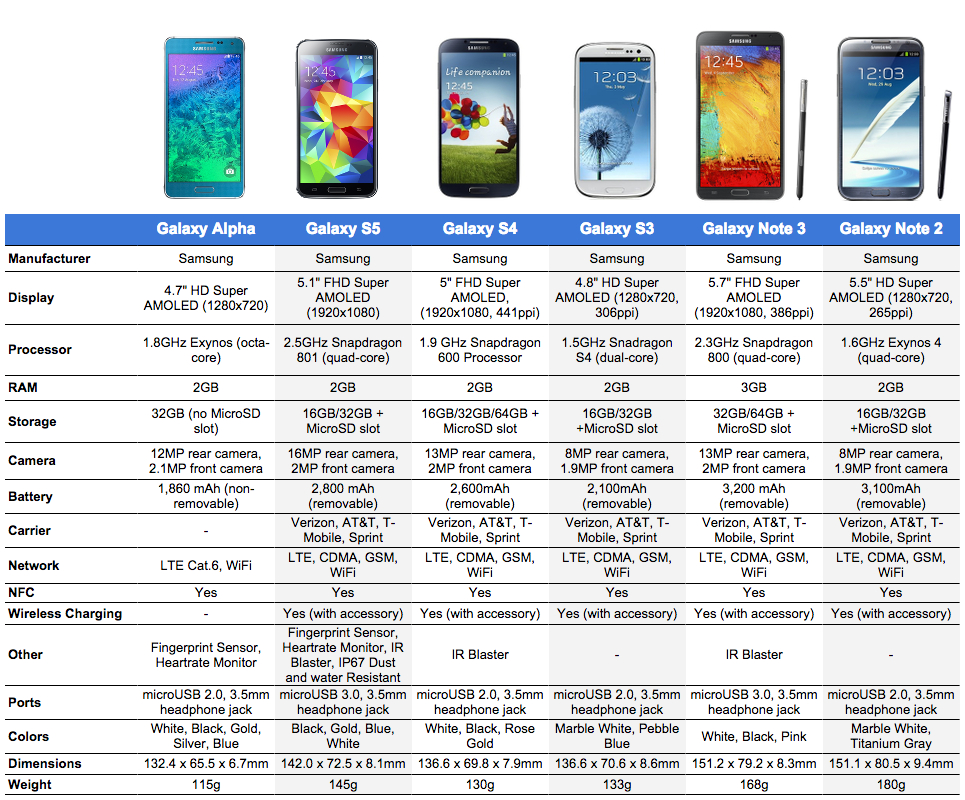
Specs Comparison: Samsung Galaxy Alpha vs. Galaxy S5, S4, S3, Note 3, and Note 2


samsung galaxy alpha silver11
Samsung made the Galaxy Alpha official this morning,
a device that looks and thinks that it is every bit as high-end as
other flagships. Unfortunately for the Alpha, its list of specs tends to
disagree with that idea, so we thought a comparison to the rest of
Samsung’s line-up of phones from the last couple of years was in-store
to show just that.


The Galaxy Alpha is leading Samsung’s new design standards by
incorporating metal in its casing, while continuing to use a variety of
textures on its backside to bring a combination that could be quite
delightful in hand. The frame (edges of the phone) is metal with
chamfered edges that resemble other premium phones on the block, like
the iPhone and HTC One (M8). The backside is still plastic, but has been
given a matte finish to blend with the shine of the metal banding. By
all means, this is Samsung’s prettiest phone to date.


But again, design isn’t everything. The Galaxy Alpha sports an HD
(720p) display, small 1,860mAh battery, and no micro SD slot. The rest
of its specs aren’t bad by any means, but when you compare the display,
battery size, and flexibility of features to the Galaxy S5, it doesn’t
quite stack up.


Still, would you be interested in the Galaxy Alpha?


galaxy alpha vs specs
| Droid Life

Tuesday, March 03, 2015

Samsung Galaxy Note 4 review | Mobile Phones Review

Some said it would never catch on, but here we are four years on from the original Galaxy Note phablet with the fourth generation device - the Samsung Galaxy Note 4.

The Galaxy Note's big screen and S Pen stylus are certainly not for everyone. The Samsung Galaxy S5 and Galaxy Alpha offer a more mainstream smartphone setup - the Note 4 brings together big power, a big screen and big productivity.

If
you're after a top-end smartphone which won't break the bank (or your
palm, pocket or handbag) then you're probably in the wrong place.


At over £600, $800 (around AU$960) SIM free the Galaxy Note 4 was heart stopping expensive at launch.

A
few months have passed now and the price of the Note 4 has dropped a
bit, but you're still looking at upwards of £500, $700 (around AU$900)
if you don't want to be tied down to a contract.

On contract in
the UK a free handset will now see you shell out upwards of £33 per
month for two years. It is a considerable investment.


Samsung Galaxy Note 4 review
The Galaxy Note 4 - king of the phablets?
The Samsung Galaxy Note 4 is up against the likes of the Nexus 6, Nokia Lumia 1520, Huawei Ascend Mate 7 and the steeply priced iPhone 6 Plus, with the latter the only one matching the Note 4 in terms of cost.

Unlike
the previous three iterations Samsung hasn't deemed it necessary to
increase the screen size of the Note 4, so it sticks with the same
5.7-inch dimensions of the Galaxy Note 3.

It's
not the same screen though, as Samsung has given the Galaxy Note 4 a
hefty resolution boost - but more on that on the next page.

When
it comes to design Samsung has definitely listened about its latest
line-up feeling plasticky in the hand and has decided to give the Note 4
more of a premium finish.


Samsung Galaxy Note 4 review
The metal frame runs round the outside
There's
a metal rim surrounding the handset, shielding the rest of the chassis
like a velvet rope protecting celebs from real people in a club.

It
sports exactly the same shape, style and rounded corners as the Galaxy
Alpha, only on a bigger scale and thanks to the increased size the
plastic rear is more noticeable here than it is on the Alpha.

Samsung
has tried to make the removable plastic cover feel more premium by
giving it a leather effect finish, but there's still no fooling your
hand with that unmistakable texture.


Samsung Galaxy Note 4 review
Still all plastic on the back.
A
plus side to this though is the plastic rear does provide good grip -
vital when you've got such a large handset in your hand and even though
the Galaxy Note 4 is a touch wider than the all metal iPhone 6 Plus, I
found the Samsung is easier to hold.

Even though the 6 Plus has a
smaller, 5.5-inch display, it's actually taller than the Note 4 -
something else the Samsung has over its Apple rival as it makes the
phone more balanced in the hand.

Add to that the placement of the
power/lock key on the right of the Galaxy Note 4 and you find that even
for a big phone the key buttons are still easy enough to reach (if your
palms are on the larger side).


Samsung Galaxy Note 4 review
It does have a lovely screen.
The
Samsung Galaxy Note 4 measures 153.5 x 78.6 x 8.5mm, almost the same as
its predecessor and smaller in width and depth than the Galaxy Note 2, which is impressive considering this is the first of the Note series to sport a metal frame.

I've also been using the 5.5-inch OnePlus One recently and there's really not a lot to choose between the two in terms of size.

It's
safe to say then, if you're already accustomed to the larger league of
smartphones then the Galaxy Note 4 will feel right at home in your palm.


Samsung Galaxy Note 4 review
There's a fingerprint scanner hidden here
I
really like the way the Galaxy Note 4 feels in the hand and having used
the Note 3 on a number of occasions, it definitely feels different and
refined enough - plus it's light too, just a touch over the weight of
the Note 3 at 176g.

Samsung's tried and tested physical home key
still resides at the bottom of the screen, providing a location for the
Korean firm to stuff in its fingerprint scanner, and that's flanked by
two touch keys.

To the left of the home button is the
Multi-tasking key, while on the right you get Back. Both Back and
Multi-tasking are completely hidden when not illuminated by the
backlights, providing a clean finish to the front of the Galaxy Note 4.


Samsung Galaxy Note 4 review
The Note 4 can be tricky to use one-handed
Some
shuffling of the Note 4 in the hand is required to get your fingers in
the right position to reach these during one handed use, and you'll need
to be careful not to drop it.

Round the back you'll find a 16MP camera, LED flash and the heart rate monitor which also features on the Galaxy S5, S5 Mini and Galaxy Alpha.

In
the bottom corner you'll also notice the end of the S Pen stylus hiding
inside the body of the Galaxy Note 4, while behind the removable rear
cover there's a microSIM port, microSD slot and a sizable 3220mAh
battery.


Samsung Galaxy Note 4 review
You'll find a 16MP camera on the back
This,
then, is the Note handset with the most premium and accomplished look
and feel to date. Samsung is finally providing the build quality its
top-end devices have been yearning for.

Samsung has managed to
keep the dimensions manageable - it's certainly a lot easier to hold
than the 6-inch Lumia 1520 and Ascend Mate 7 - and while the iPhone 6
Plus may look sleeker, the Galaxy Note 4 boasts a bigger, better screen
and very similar dimensions.

 | TechRadar

Sunday, March 01, 2015

Samsung Galaxy Note 4 vs Note 3: Is it worth the upgrade?

Samsung Galaxy Note 4 vs Note 3: Is it worth the upgrade?

Note 3 or Note 4? Here's our verdict on the Samsung phablets

Samsung's phablet has paved the way for oversized phones to become the norm. Now the likes of the Xperia Z3, the HTC One M8 and even the iPhone 6 Plus have proved that big is the way forward.

The Galaxy Note 4 is in a league of its own. But how does it compare to the previous model, the Samsung Galaxy Note 3? We thought last year’s version was great, if not quite perfect.

Has
Samsung finally perfected the design in the Galaxy Note 4? It certainly
seems like it might have. Spending some time with both handsets, here's
why we think you should make the upgrade.

Samsung Galaxy Note 4 vs Note 3: Design

Samsung Galaxy Note 4: Plastic, Metal trim, removable back, 176g, 8.5mm thick
Samsung Galaxy Note 3:
Plastic, Leather effect removable back, 168g, 8.3mm thick

The
most common criticism of Samsung phones is that they often don’t look
or feel all that expensive. The company is trying to address this with
phones such as the Samsung Galaxy Alpha and the new Note 4. Thankfully, it shows.

There's
still the leather-effect plastic back, but rather than having naff
chromed plastic running around the sides, the Note 4 use real metal.
It's a cool anodised aluminum finish that's a darker shade than the one
found on the Alpha.

Samsung's also managed to slim down the
bezel even further this year. There’s hardly any bezel on the Galaxy
Note 4 at all, making it ever so slightly narrower than the Note 3. This
makes it a little easier to handle, and the gently curved back also
makes it fit more snugly for one-handed operation.

The texture on
the back has been changed a little, too. While still essentially based
on the texture of leather, it’s a bit less of an obvious copy this time.
The cartoonish stitching of the Note 3, which is actually just a
pattern embossed into the plastic, has been binned in favour of
something a bit lower-key, a bit classier.

The silhouette of the
phone is also a tiny bit different, with a boxier design. Samsung's
gradually sharpened up the Note series’ curves since it began in 2011,
presumably in an attempt to shave off some excess fat.

As ever,
the Note 4’s S Pen stylus slots into the bottom of the phone. The
changes Samsung's made are all positive ones, and for that reason the
new Note wins on the design front.

SEE ALSO: iPhone 6 Plus vs Note 4: Battle of the big phones

Samsung Galaxy Note 4 vs Note 3: Hardware extras

Samsung Galaxy Note 4: Heart-rate sensor and fingerprint scanner
Samsung Galaxy Note 3: More
conventional IR transmitter and NFCThe S Pen is, to a large extent,
what the Note series is all about. However, the Samsung Galaxy Note 4
also benefits from a few other bells and whistles that hadn’t yet been
made ‘standard’ across top Samsung phones last year when the Note 3 came
out.

We’re talking about the fingerprint scanner and heart-rate sensor. Both were introduced in the Samsung Galaxy S5, and both are found in the Galaxy Note 4, but not the Note 3.

The
fingerprint scanner sits underneath the Home button under the screen,
and can be used to unlock the phone and authorise PayPal payments. It’s a
neat extra, especially as something to show off to iPhone 6-owning
friends who brag about their Touch ID sensors. Can you live without it?
We'd say yes.

However, we really don’t think it’s one of the Note
4’s more important changes. As you have to glide your finger over the
centre of it rather than just holding a digit there, it doesn’t always
work, especially when you’re trying to do it quickly.

The
heart-rate sensor on the back is less problematic, but it’s also less
remarkable. Using S Health you can track your heart rate on the Note 4,
but you can monitor your heart rate pretty easily with just about any
phone as long as it has a rear camera and an LED flash near the lens.
Aside from those hardware requirements, all you need is a heart-rate app
– there are free ones on Google Play.

There’s new stuff, certainly. But these little extras don’t merit upgrading from the Note 3 to the Note 4, in our opinion.

Both phones have most extras you might see in other high-end, feature-packed phones, such as an IR transmitter and NFC.
Note 3 S-Pen (top) and Note 4 S-Pen (bottom)

Samsung Galaxy Note 4 vs Note 3: S Pen

Samsung Galaxy Note 4: 2048 dps pressure sensitivity
Samsung Galaxy Note 3:
1024 dps pressure sensitivity

If
hardware extras are what you’re after, the Note series' S Pen is where
it’s at. While there are some new software features this time around,
the core hardware that makes the Note 4’s S Pen stylus possible is
similar to the Note 3’s.

Both styli use a digitiser layer in the
screen that enables the use of a pressure-sensitive accessory that
doesn’t need its own power source. And the result is something special.

Although
not widely publicised, the S Pen technology is powered by Wacom, the
company that makes the most popular professional-grade graphics tablets.
As well as being pressure-sensitive, this technology means the Note 3
and Note 4 can sense the presence of the pen before it even touches the
screen.

The new software tweaks within the Note 4 focus on
opening up the creative potential of the S Pen stylus and making it
easier to use. This includes the ability to select copy in web pages
when previously you had to go through the more fussy process of cutting
it out. Sensitivity has also been massively increased this time around,
with the Note 4 able to sense 2048 levels of pressure to the Note 3’s
1024. It’s real high-end hardware.

Writing and drawing is more
fluid, making this still one of the best styli bundled with a tablet,
perhaps only rivalled by the one supplied with the Nvidia Shield tablet.

SEE ALSO: Note 4 apps that need to get better

Samsung Galaxy Note 4 vs Note 3: Screen

Samsung Galaxy Note 4: 5.7-inch 2560 x 1600-pixel Super AMOLED
Samsung Galaxy Note 3:

5.7-inch 1920 x 1080-pixel Super AMOLEDThe Samsung Galaxy Note 4 has
quite a remarkable screen. It’s the first QHD Super AMOLED phone display
and is a big step up from the Note 3's Full HD display.

This
provides the same sort of ridiculously high pixel density you get in
something like the LG G3, but with the additional benefits of a Super
AMOLED panel. Pixel density is much, much higher than the Note 3, which
uses a slightly more conventional 5.7-inch 1080p Super AMOLED screen.

So,
both displays are the same size, but the Galaxy Note 4’s is a lot
sharper – with a whopping 515ppi pixel density. There's some question
as to whether this extra sharpness really makes all that much
difference, as the 386ppi Note 3 is still very sharp, but the more
discerning among you will be able to spot the upgrade.

What really makes a good impression is the same colour accuracy that Samsung introduced in the Galaxy
S5. Use the Cinema or Photo modes in the latest Samsung phones and
you’ll get really wonderful colour reproduction.

If you want one of the best screens there is on a phone, then the Note 4 is the winner here.

Samsung Galaxy Note 4 vs Note 3: CPU and Power

Samsung Galaxy Note 4: Exynos 5433 or Snapdragon 805
Samsung Galaxy Note 3: Exynos Octa 5420 or Snapdragon 800

With
the top Samsung phones, assessing power isn't always just a case of
looking at one CPU. Both the Note 3 and Note 4 come in different
variations that use Qualcomm Snapdragon processors and Samsung’s own
Exynos ones.

Last year, we much preferred the Snapdragon 800
version of the Note 3 to the Exynos 5420 one. The Exynos sounded more
exciting, as it has eight cores rather than four, but as the Note 3 can
only use four at once, you don’t really get octa-core power. The design
is really more about efficiency.

This year, the situation is a
little different. The Snapdragon 805 version of the Note 4 uses a 32-bit
CPU, but the Exynos 5420 is a true 64-bit processor. We’re actually
slightly disappointed to see the Note 4 use a 32-bit CPU when the 64-bit
future is on the horizon. It really matters because Android 5.0 Lollipop will soon bring full support for 64-bit processors.

But how do the two generations of Snapdragon and Exynos chipsets compare?

The
Snapdragon 805 is not a huge step up from the 801 of the Galaxy S5 or
the 800 of the Note 3. They use the same Krait-based architecture, and
each is basically a turbocharged version of its predecessor. You get
more power, but technically they’re fairly similar.

SEE ALSO:
Samsung Galaxy S5 vs Note 4
The
Note 3’s Snapdragon 800 is a 2.3GHz processor, while the Note 4’s 805 a
2.7GHz one. However, it’s in the GPU that we see the real performance
boost.

The Adreno 420 of the Note 4 is about 40 per cent more
powerful than the Adreno 330 of the Note 3. It’s this that'll make the
new phone capable of handling high-end 3D games at native 2560 x
1600-pixel resolution without dropping any effects.

So what
about the Exynos 5433? We could easily call this what the Exynos
octa-core processor should always have been. Unlike the Note 3’s Exynos
5420, all eight cores can be used at once, and it’s a real 64-bit
processor. It’s the future, in other words.

Having a 64-bit
processor also means the Note 4’s 4GB of RAM makes a good deal more
sense. In a 32-bit system, the amount of memory that can be addressed at
once is limited to 4GB, meaning that having any more than 4GB is
pointless, and even the whole 4GB generally won’t be able to be used.

There’s
no such limit with a 64-bit system, where the addressable memory space
is so vast that it doesn’t bear thinking about in mobile terms.

Both
phones are well equipped in the power department, so you should have no
problem with more intensive multitasking operations.

Samsung Galaxy Note 4 vs Note 3: Software

Samsung Galaxy Note 4: Android 4.4 KitKat with TouchWiz UI
Samsung Galaxy Note 3:
Android 4.3 JellyBean with TouchWiz UI

Like
all of Samsung’s top-end phones, the Note 4 will use a version of the
custom Samsung Android UI. However, the Note 4’s is a generation on from
the Note 3’s.

It benefits from the improvements made in the
revamped version of the TouchWiz UI seen in the Galaxy S5. That means a
bit less bloat, some simpler visual style points and the new settings
menu. It’s a bit overblown, with its simplification backfiring on
occasion, but it’s not bad. And generally it looks better than the Note
3’s interface.

The good news is that along with stripping back
the bloatware, some of the more gimmicky settings have been left out of
the Note 4. The underwhelming Magazine UX has gone, too, replaced with a
new Flipboard-powered widget.

Arguably the Note's best software
feature is MultiWindow, and it's even better on the Note 4. The Samsung
phone's big screen is ideal for running multiple apps at the same time,
and now you have the added bonus of being able to run pop-up windows
that you can move around the screen.

Samsung Galaxy Note 4 vs Note 3: Camera

Samsung Galaxy Note 4: 16-megapixel Sony sensor with OIS, LED flash
Samsung Galaxy Note 3: 13-megapixel sensor, LED flash

Last year, we found that the Note 3 had a slightly worse, but essentially similar, camera to the Galaxy S4. This year, the Note 4 may even have a slightly better camera than the Galaxy S5.

The
Note 3 has a 13-megapixel main sensor and the Note 4 a 16-megapixel
sensor, both made by Sony. The Galaxy S5 has a Samsung-made ISOCELL
sensor that we wish had made its way into the Note 4, because it’s
fantastic.

Samsung’s previous camera sensors haven’t been much
to brag about, but the 16-megapixel ISOCELL sensor in the Galaxy S5 is
pretty special. The Note 4's sensor is a bit more conventional, but it's
still a lot better than the Note 3’s.
Note 3
Samsung Galaxy Note 3 photo sample
Note 4
Samsung Galaxy Note 4 photo sample

With
OIS on-board this is one of the best all-round cameras we've used.
Optical Image Stabilisation means you'll experience less hand-shake blur
when using slower shutter speeds in low light, which in turn means more
light will get to the pixels. The Note 4 also offers an improved
front-mounted selfie camera, with a 3.7-megapixel sensor to the Note 3’s
2-megapixel one.

It builds on the S5's shooting functionality,
making it one of the best all-round smartphone cameras we've used.
Whether it's close-up macro-style images or from a distance, the Note 4
delivers greater detail, improved sharpness and generally more vibrant
image quality compared to the Note 3.

HDR mode is one of
Samsung's strengths and it really impresses on the new Samsung phablet.
While low-light shooting isn't entirely free from some image noise, OIS
does manage to produce brighter, more detailed images when shooting
conditions are more challenging.

Like the S5 and the Note 3 you
can shoot video at up to 4K resolution, although you have to sacrifice
some of the more useful camera modes such as Dual Camera and HDR. That's
not a big issue here, as Full HD 1080p footage is still strong and the
addition of optical video stabilisation is another reason you'll get
better results from the new Note.


Next, read our round-up of the latest
Samsung Galaxy Note 5 rumours

Verdict

If
we’re honest, we were a tiny bit disappointed with the Note 3 when it
arrived. It just wasn’t quite the upgrade over the Note 2 that we were
hoping for.

With the Note 4 it's an entirely different story.
There's the design improvements, a better camera and the screen is a
massive upgrade from the Note 3. If you're buying the Note 4 for the S
Pen, the software that makes best use of it isn't radically different,
but it's a more fluid and accurate experience.

The Note 4 is
still one of the priciest big phones to buy, but if you are sold on the
Galaxy Note vision, then it's a no-brainer to make the upgrade.
 - Trusted Reviews

Friday, February 27, 2015

Samsung Galaxy Note 4 vs Galaxy Alpha: Battle of the Better Galaxy, Go Fab with Phablet or Slick and Classy with Alpha?

Samsung Galaxy Note 4 vs Galaxy Alpha

Samsung Galaxy Note 4 vs Galaxy Alpha: Battle of the Better Galaxy, Go Fab with Phablet or Slick and Classy with Alpha?


With the series of smartphone launches and announcements that Samsung
made, two in particular stood out; the Samsung Galaxy Note 4 and the
Samsung Galaxy Alpha.


According to CNET, the Samsung Galaxy Note 4 packs a stunning 5.7
inches of Quad HD AMOLED display. This means that the phone has a pixel
resolution of 2,650 x 1440 pixels and 515 pixels per inch density, which
completely blows competing smartphones out of the water.


The Samsung Galaxy Alpha comes with a humble 4.7 inches of 720 pixel
Super AMOLED screen. Even with the quaint 720p screen, the display still
looks gorgeous and colorful, according to Droid Life.


The Galaxy Note 4 also packs quite a punch against the Galaxy Alpha
in terms of their processors. The former comes equipped with either the
1.9 GHz Octa-core Exynos 5433 or the 2.7 GHZ Qualcomm Snapdragon 805
chipset bundled with a graphic processing unit of the Adreno 420. It
also has 3 GBs of RAM for multitasking and heavy gaming.


However, the Galaxy Alpha doesn't go too far as it comes packed with a
2.5 GHz Snapdragon 801 processor and an also quite big 2GBs of RAM. It
can still compete with the Galaxy Note 4's Qualcomm chipset by an inch.


Taking pictures is far better on the Galaxy Note 4 as it has a 16
megapixel rear camera with a very useful OIS or optical image
stabilization. The OIS keeps pictures from being blurry or out of focus
by internally balancing the jittery hands of the user when they take
photos. For selfies, the Note 4 comes with a 3.7 megapixel camera.


This time, the Galaxy Alpha is a little bit far behind the camera
game. It is equipped with a 12 megapixel camera in the rear and a 2.1
megapixel camera for the front.


Both devices have 32GBs of internal storage.


While the Galaxy Alpha has its own feature advantages like the
fingerprint scanner, the Galaxy Note 4 has a larger battery capacity of
3,220 mAh. The clear winner is the Samsung Galaxy Note 4, but consumers
will have to dish out over $600 for the phablet. In the end, it still
boils down on the buyers' preferences, budget, and intentions with the
phone.

 : Trending : Hallels

Wednesday, February 25, 2015

Samsung Note 4 & Alpha Teardown

Samsung released their latest 5.7inch flagship Galaxy Note 4 ahead of
schedule in South Korea, and then followed it up with the release of
the Samsung Galaxy Alpha in Europe. The Galaxy Alpha with its 4.7 inch
display is Samsung's thinnest and first metal-framed device in their
Galaxy product line to date. Both devices are the Samsung alternatives
to Apple's iPhone 6 Plus and iPhone 6 phones released on September 19.


Apple iPhone Comparison
Figure 1: Samsung Galaxy Note 4 & Galaxy Alpha
Both the Note 4 SM-N910K and Galaxy Alpha SM-G850F relied on
Samsung's own Exynos application processors, the Exynos 5433 and the
Exynos 5430 respectively.


Apple iPhone Comparison
Figure 2: Samsung Galaxy Note 4 Exynos 5433 & Samsung Galaxy Alpha Exynos 5430
Unlike the Apple iPhone 6 and iPhone 6 Plus devices which both used
the same baseband processor, the Qualcomm MDM9525M, Samsung brings the
Intel X-Gold PMB9933 XG726G into the Alpha, and Samsung’s own Shannon
303 into the Galaxy Note 4. There are rumors the basebands will be
different in the models released for the US market.


In the Galaxy Note 4, Samsung used many of their Shannon chipsets to
support other functions such as power management, RF, and one IC who's
function we have not yet determined. TechInsights first spotted Shannon
in
the Samsung Galaxy Lite SGH-T399 in 2013 and again in the recently
released Samsung S5 Mini SM-G800F. However in those devices, Shannon
was only used for power management and the RF transceivers. With the
addition of so many of the Shannon ICs in a flagship like the Galaxy
Note 4, it would appear Samsung is expanding Shannon into becoming an
entire design solution.


Overall, Samsung takes the majority of the design wins in the Galaxy
Note 4 with the Shannon ICs and other Samsung components such as the
Exynos 5433 processor. Both the Galaxy Alpha and Note 4 use S3FWRN for
the NFC controller, S5C72C for image processing, as well as the Samsung
memory ICs.


Galaxy Note 4 Board Shots


  • Apple iPhone 6 Teardown


  • Apple iPhone 6 Teardown


  • Major Component List / Design Wins

    Front Board Shot
    • Samsung Shannon 303 Baseband Processor
    • Samsung K4P1G324EQ-MGC1 Mobile DDR2-S4 SDRAM - 128 MB
    • Samsung Shannon 60X6R8 Power Management
    • Maxim MAX77843 USB Interface / Li-Ion Battery Charger
    • Avago ACPM-8117 RF Power Amplifier Module
    • Maxim MAX98504 Audio Amplifier
    • Samsung KMR21000AM-A805 Multi-chip Memory - 3 GB LPDDR3 SDRAM, 32 GB MLC
    • Samsung Exynos 5433 Exynos 5 Applications Processor
    • Wacom W9012 Digitizer Controller Module
    • Samsung S5C72C1A01 Image Processor
    • Samsung S3FWRN NFC Controller
    • Bosh Sensortec BMP180 Digital Barometric Pressure Sensor
    • Yamaha YAS532B 3-Axis Electronic Compass


    Galaxy Alpha Board Shots


  • Apple iPhone 6 Teardown


  • Apple iPhone 6 Teardown


  • Major Component List / Design Wins

    Front Board Shot
    • Intel PMB9933 XG726G X-Gold Baseband Processor
    • Samsung KMR2M0009M-A803 Multi-chip Memory - 2 GB LPDDR3 SDRAM, 32 GB MLC
    • Maxim MAX77804 Interface PMIC
    • Murata E702A7 WiFi/Bluetooth Module
    • RF Micro Devices RF8095 Multi-mode - Multi-band Power Amplifier
    • Skyworks SKY7851 Antenna Switch
    • RF Micro Devices RF8081A Envelope Power Tracking
    • Yamaha YAS532B 3-Axis Electronic Compass
    • Samsung Exynos 5430 Applications Processor
    • Wolfson Microelectronics WM5110E Audio Hub CODEC w/ Voice Processor DSP
    • Samsung S5C72C1A01 Image Processor
    • Broadcom BCM47531 GPS / GNSS Receiver

    Cypress Semiconductor takes its usual spot in both devices,
    supporting the lower two touch buttons. In the Galaxy Note 4 our analyst
    found the CY8CMBR3155-LQXI capacitive touch controller, part of the
    Cypress Semiconductor CapSense portfolio.


    Apple iPhone Comparison
    Figure 3: Cypress Semiconductor Touch Controller in Galaxy Note 4

    Unknown WiFi / Bluetooth Module

    It is unknown which manufacturer is supporting the WiFi / Bluetooth /
    ANT+ features in either the Galaxy Alpha or Galaxy Note 4. Both of the
    phones have a similar multi-die module found in other Samsung Galaxy S5
    phones where the the WiFI / Bluetooth controller ICs were embedded.


    Design Win Surprise

    Our analysts found two different STMicroelectronics touchscreen
    controllers in the Display / Touchscreen subsystems of the Samsung
    Galaxy Alpha and the Galaxy Note 4. We suspect these are both two-die
    packages and will confirm it in our Deep Dive analysis of both products
    in the coming weeks.


    Apple iPhone Comparison
    Apple iPhone Comparison
    Figure 4: STMicroelectronics Touchscreen Controllers Found in Galaxy Note 4 & Alpha

    CoG Quick Estimates

    All four devices are currently in process for a full Deep Dive
    analysis. The Apple iPhone 6 and iPhone 6 Plus reports are expected to
    be completed at the end of October, 2014. The Samsung reports are
    expected to be available at the beginning of December.


    Apple iPhone Comparison
    Figure 5: Estimated Costs Comparison of the Galaxy Alpha, iPhone 6, Galaxy Note 4, and the iPhone 6 Plus

    Displays and Touchscreens

    The final cost of the Galaxy Note 4 is estimated to be higher than
    the iPhone 6 Plus. This is greatly due to the higher priced Display /
    Touchscreen subsystem cost of the Galaxy Note 4. The Super AMOLED
    display of the Note 4 has a cost premium which increases as the panel
    size increases. Also impacting the costs of the Note 4 display is higher
    pixel count.


    Apple iPhone Comparison
    Figure 6: Samsung Galaxy Note 4 & Apple iPhone 6 Plus Display Specifications

    The Takeaways

    An initial design win observation of the Galaxy Alpha, Samsung tapped
    themselves to support applications with the Exynos 5430 with support
    from their own memory ICs. For envelope power tracking. instead of using
    the R2AA217C from the reclusive R2 Semiconductor (as they did in the
    Samsung Galaxy S5 mini), Samsung used the RFMD RF8081A. Other than
    finding STMicroelectronics supporting the main touchscreen controller
    function, there were not any significant design changes from other
    Samsung Galaxy phones.
    The Galaxy Note 4 did surprise us with the STMicroelectronics touch
    solution and with the number of ICs from Samsung's Shannon chipset. The
    Shannon ICs and the number of additional Samsung ICs seen in the Galaxy
    Note 4 may suggest Samsung is not only hard at work at designing their
    own total design solution for mobile devices, but they are also willing
    to use their own designs in their high-end, flagship smartphones.


    Monday, February 23, 2015

    Samsung Galaxy Note 4 vs Samsung Galaxy Alpha - Phone specs comparison

    phonephone

    Design
    Device typeGalaxy Note 4 Galaxy Alpha
    OSAndroid (5.0, 4.4)Android (4.4.4) TouchWiz UI
    Dimensions6.04 x 3.09 x 0.33 inches (153.5 x 78.6 x 8.5 mm)5.21 x 2.58 x 0.26 inches (132.4 x 65.5 x 6.7 mm )
    Weight6.21 oz (176 g)

    the average is 4.8 oz (138 g)
    4.06 oz (115 g)

    the average is 4.8 oz (138 g)
    Display
    Physical size5.7 inches4.7 inches
    Resolution1440 x 2560 pixels720 x 1280 pixels
    Pixel density
    515 ppi312 ppi
    Technology
    Super AMOLEDSuper AMOLED
    Screen-to-body ratio74.39 %70.22 %
    Colors16 777 21616 777 216
    TouchscreenMulti-touchMulti-touch
    FeaturesLight sensor, Proximity sensor, Scratch-resistant glass (Corning Gorilla Glass 4)Light sensor, Proximity sensor, Scratch-resistant glass (Corning Gorilla Glass 4)
    Camera
    Camera16 megapixels12 megapixels
    FlashLEDLED
    Aperture sizeF2.2F2.2
    Focal length (35mm equivalent)31 mm31 mm
    Camera sensor size1/2.6"
    FeaturesBack-illuminated
    sensor (BSI), Autofocus, Touch to focus, Manual focus, Digital image
    stabilization, Optical image stabilization, Face detection, Smile
    detection, Exposure compensation, ISO control, White balance presets,
    Burst mode, Digital zoom, Geo tagging, High Dynamic Range mode (HDR),
    Panorama, Macro mode, Night mode, Scenes, Effects, Self-timer, Voice
    activation
    CMOS image sensor, Autofocus, Touch to focus, Manual
    focus, Digital image stabilization, Face detection, Smile detection,
    Exposure compensation, ISO control, White balance presets, Burst mode,
    Digital zoom, Geo tagging, High Dynamic Range mode (HDR), Panorama,
    Scenes, Effects
    Camcorder3840x2160 (4K) (30 fps), 1920x1080 (1080p HD) (60 fps)3840x2160 (4K) (30 fps), 1920x1080 (1080p HD) (60 fps), 1280x720 (720p HD) (120 fps)
    FeaturesOptical image stabilization, Continuous autofocus, Picture-taking during video recordingDigital image stabilization, High Dynamic Range mode (HDR)
    Front-facing camera3.7 megapixels2.1 megapixels
    Hardware
    System chip
    Exynos Octa 7Exynos 5 5430
    Processor
    8-core, 1900 MHz, ARM Cortex-A57 and ARM Cortex-A538-core, 1800 MHz, ARM Cortex-A15 and ARM Cortex-A7
    Graphics processorARM Mali-T760ARM Mali-T628 MP6
    System memory
    3072 MB RAM2048 MB RAM
    Built-in storage32 GB32 GB
    Maximum User Storage25 GB
    Storage expansionmicroSD, microSDHC, microSDXC up to 128 GB
    Battery
    Talk time (3G)20.00 hours

    the average is 15 h (921 min)
    11.00 hours

    the average is 15 h (921 min)
    Capacity3220 mAh1860 mAh
    Multimedia
    Music player
    Filter byAlbum, Artist, PlaylistsAlbum, Artist, Playlists
    FeaturesAlbum art cover, Background playbackAlbum art cover, Background playback
    RadioFM
    SpeakersEarpiece, LoudspeakerEarpiece, Loudspeaker
    YouTube playerYesYes
    Internet browsing
    BrowserGoogle ChromeGoogle Chrome
    Built-in online services supportYouTube (upload), Picasa/Google+YouTube (upload), Picasa/Google+
    Technology
    GSM850, 900, 1800, 1900 MHz850, 900, 1800, 1900 MHz
    UMTS850, 900, 1900, 2100 MHz850, 900, 1900, 2100 MHz
    FDD LTE700 (band
    17), 800 (band 20), 850 (band 5), 900 (band 8), 1700/2100 (band 4), 1800
    (band 3), 1900 (band 2), 2100 (band 1), 2600 (band 7) MHz
    800 (band 20), 850 (band 5), 900 (band 8), 1800 (band 3), 1900 (band 2), 2100 (band 1), 2600 (band 7) MHz
    DataLTE Cat 4 (150/50 Mbit/s), HSDPA+ (4G) 42.2 Mbit/s, HSUPA, EDGE, GPRSLTE-A Cat 6 (300/50 Mbit/s), HSDPA+ (4G) 21.1 Mbit/s, EDGE, GPRS
    Micro SIMYes
    nano-SIMYes
    Positioning
    GPS, A-GPS, GlonassGPS, A-GPS, Glonass
    NavigationTurn-by-turn navigation, Voice navigationYes
    Connectivity
    Bluetooth4.1, EDR4.0
    Wi-Fi802.11 a, b, g, n, n 5GHz, ac802.11 a, b, g, n, n 5GHz, ac
    Mobile hotspotYesYes
    USBUSB 2.0USB 2.0
    ConnectormicroUSBmicroUSB
    FeaturesMass storage device, USB Host, USB chargingMass storage device, USB charging
    OtherNFC, DLNA, MHL, Tethering, Computer sync, OTA sync, ANT+, Infrared, MirrorLinkNFC, DLNA, Tethering, Computer sync, OTA sync, ANT+
    Other features
    NotificationsHaptic feedback, Music ringtones (MP3, WAV), Polyphonic ringtones, Vibration, Flight mode, Silent mode, SpeakerphoneHaptic feedback, Music ringtones (MP3), Polyphonic ringtones, Vibration, Flight mode, Silent mode, Speakerphone
    Additional microphone(s)for Noise cancellation
    SensorsAccelerometer, Gyroscope, Compass, Hall, Fingerprint ID, Gesture, BarometerAccelerometer, Gyroscope, Compass, Hall, Fingerprint ID, Gesture
    OtherVoice dialing, Voice commands, Voice recordingVoice dialing, Voice commands, Voice recording
     - Phone specs comparison
     

    Sample text

    Sample Text

    Sample Text